Get Full Government Meeting Transcripts, Videos, & Alerts Forever!
Get email alerts on the Reed Avenue Project topic
No spam. Unsubscribe anytime.
Cheyenne finance panel advances Reed Avenue corridor funding after engineering briefing
Summary
After a staff presentation and public comment, the finance committee voted to recommend approval on second reading of the Reed Avenue corridor appropriation, contingent on a final written agreement with Burlington Northern Santa Fe Railroad and further design work and funding alignment.
City engineers and council members on April 7 laid out the next steps for the Reed Avenue rail-corridor project and the committee voted to recommend the ordinance’s approval on second reading, provided the city reaches a final written agreement with Burlington Northern Santa Fe Railroad (BNSF).
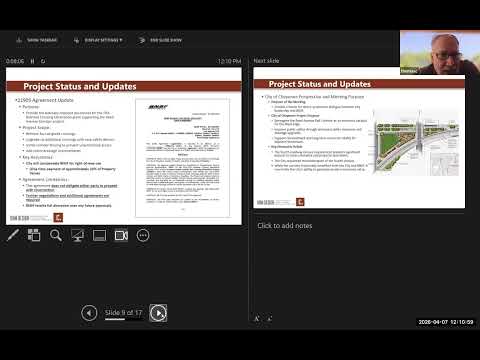
Tom Cobb, the city engineer, told the finance committee that the project is advancing through the BNSF and Federal Railroad Administration processes and that the city is preparing 60% design plans and a contract modification to expand adjacent side-street work. Cobb said an FRA crossing-elimination grant requires a “2295” agreement spelling out the project scope and federal assurances, and that the agreement — as described in staff remarks — would include removal of four active crossings, upgrades at six additional crossings, corridor fencing, and stormwater drainage improvements.
"The agreement doesn't obligate either party to proceed with construction," Cobb said, adding that a separate construction-and-maintenance agreement will be required before the city can spend funds on construction. He also said the city will pay a one-time right-of-way compensation to BNSF based on appraisal work; staff estimated the maximum payment at roughly $210,000.
Why it matters: the Reed Avenue corridor is framed by city staff as an economic catalyst for Cheyenne’s west edge, intended to improve safety and drainage while encouraging reinvestment in adjacent properties. Cobb described a recent meeting with BNSF and Mayor Patrick Collins in which the railroad stressed safety, operations and liability concerns and the city pushed for redevelopment opportunities.
BNSF requested closures of multiple crossings; Cobb said the railroad determined the number of closures and staff used a Shine regional traffic-demand model to pick closure locations by lowest average daily traffic and projected 2050 volumes. Cobb said that, after discussion, BNSF accepted a compromise that would allow an eight-foot pedestrian corridor on the west side of the rail line to maintain pedestrian access without reopening vehicle crossings.
Council members pressed staff on details. Councilman Moody asked whether the traffic model accounted for recent apartment construction and whether any study of potential gentrification had been done; Cobb said the model treats redevelopment in aggregate and he was not aware of a gentrification study. On schedule, Cobb estimated roughly six months to complete the 60% plans and about a year for final design, subject to BNSF review timelines.
Public commenters and local business owners spoke in favor of the project. "We've waited long enough," said Tony Lucero of ANC Feed, praising progress and urging council to move from planning to construction. Resident Darren Westby said recent private investments and visible neighborhood improvements reinforced local support.
Councilman White emphasized an explicit funding safeguard in the ordinance. He read section two aloud and said, "No funds shall be expended from this commitment until a final agreement with Burlington Northern Santa Fe Railroad has been reached," pointing out that the city would not spend money until written permission from BNSF is in hand.
Staff summarized current funding as roughly $3.4 million from the FRA grant (including an $800,000 city match) and about $2.21 million remaining in the Six-Penny fund, for approximately $5.62 million available in total; Cobb said an estimated $350,000 change order could be needed for extended roadway components. Cobb also noted the city will pursue grants and other funding opportunities and continue meetings with property owners.
The motion to approve the ordinance on second reading was moved by Councilman White and seconded by Councilman Wolf; the committee signified approval and will forward its recommendation to the governing body. The ordinance, as discussed in committee, includes the requirement that the city secure a final written agreement with BNSF before funds are expended.
Next steps: staff will complete the 60% design, continue property-owner coordination and finalize the FRA '2295' agreement and a later construction-and-maintenance agreement with BNSF. The ordinance will go to the governing body for final action.