Get Full Government Meeting Transcripts, Videos, & Alerts Forever!
Get email alerts on the Weed Management topic
No spam. Unsubscribe anytime.
Carbondale parks commission approves integrated weed-management plan, stresses staffing needs
Summary
After a presentation by facilities maintenance lead Chris Gleason, the Carbondale Parks and Recreation Commission approved the town's integrated weed management plan and asked staff to proceed with scheduled nonchemical methods while trustees review funding for future excavation work.
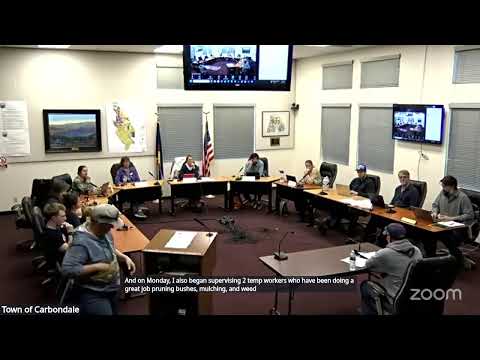
At its March 11, 2026 meeting, the Carbondale Parks and Recreation Commission voted to approve the town's annual integrated weed management plan after a detailed presentation by facility maintenance lead Chris Gleason.
Gleason told commissioners he is prohibited from using toxic herbicides on town lands and that the policy protects residents and park users from exposure to persistent chemicals. He described an array of alternatives the department will rely on this season, including manual extraction, propane torch burning, non-toxic sprays (commercial products and concentrated vinegar mixes), road salt for infields, biological controls and a limited goat pilot. "Although spraying herbicide is the most effective way to kill invasives, we have seen that other methods can be effective and they just require more human resources," Gleason said. He added, "I am not allowed to spray toxic herbicides. And I think that's a great thing." (Chris Gleason, facility maintenance lead.)
Commission discussion focused on the labor and budget trade-offs of a chemical ban. Staff and commissioners said using seasonal temporary workers has worked well when demand spikes; Gleason said recent hires performed reliably and that a larger temp budget this year should improve results. For sites with entrenched infestations, like Triangle Field, Gleason said the only nonchemical option would be excavation, installation of weed barrier and new infield material — work the department cannot fund in the current year but may prioritize in future budgets.
The commission approved the plan by voice vote; the transcript did not record the motion mover or a roll-call tally. Eric Breninger, the town's parks and recreation director, told the commission that trustees will be briefed on the plan and that new trustees will be educated about the program before final implementation steps.
What happens next: staff said on-record they will begin nonchemical treatments immediately at selected sites and will report results to the commission; excavation and major capital work will be considered in future budget cycles or when specific funding (for example for Triangle Field) becomes available.