Get Full Government Meeting Transcripts, Videos, & Alerts Forever!
Get email alerts on the Special Education Continuum topic
No spam. Unsubscribe anytime.
Bernards Township supervisors outline special-education continuum from preschool through age 21
Summary
Supervisors for Bernards Township School District presented a walkthrough of the district's special-education continuum — preschool PALS and CBAP, K'5 LLD and Bridges self-contained classes, middle- and high-school supports, and transition-to-work services — emphasizing individualized IEP-driven placement and behavior supports.
The Bernards Township School District laid out its continuum of special-education programs in a presentation that covered services from preschool through transition planning up to age 21.
The district director opened the session, saying the meeting was an introductory workshop and that parents could follow up with case managers or supervisors for individual questions. The director framed program placement as an annual IEP-team decision, required under IDEA, and said the district offers a range of service models from least- to most-restrictive.
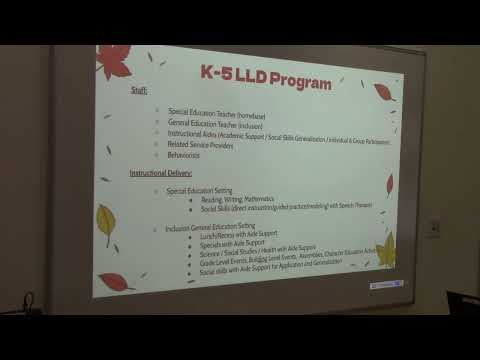
Lisa Stanion, the district's K'5 special-education supervisor, described the Language Learning Disabilities (LLD) classroom as staffed by a special-education teacher who serves as the home-room teacher, a linked general-education teacher for inclusion, instructional aides and related-service providers (OT, PT, speech). "Instruction in the LLD classroom is layered on the general-education core, but with flexible pacing and individualized goals," Stanion said, adding that speech pathologists often provide pragmatic- and social-skills supports within the LLD setting.
Stanion also outlined the Bridges program, the district's behavior-focused self-contained class located at Cedar Hill. Bridges includes a special-education teacher, a de-escalation teacher, aides trained in the program's common language and a point-based behavior system designed to provide consistent feedback. Stanion said de-escalation is intended to be a learning opportunity rather than a punishment: "It's a private area where we de-escalate so we can talk through what's bothering the student and keep their dignity," she said.
Dr. Allison Reed, who oversees preschool programming, described the district's two preschool options: a half-day PALS program (Preschool for All Learning Styles) and a full-day Comprehensive Behavior Analytic Program (CBAP). She said preschool referrals come from early-intervention case managers, local preschools, pediatricians and parents; evaluations involve a child-study team, related therapists and school clinicians.
Reed emphasized language development as foundational: "Language is everything — it's the baseline component of everything," she said, adding that speech-language supports are embedded in preschool classrooms to promote generalization. She described CBAP and other self-contained classes as using Applied Behavior Analysis principles, frequent data collection (skill-acquisition graphs), token-economy or point systems and small-group and individualized instruction to build functional skills.
At the elementary level the district runs peer-inclusion programs such as Buddy Builders at Mount Prospect and Oak Street, which pairs fourth- and fifth-grade volunteers with students in self-contained classes during recess and activities to foster friendships and social skills. In middle school, Reed said LLD students follow a schedule of content-area classes run by LLD-experienced teachers and are supported by consistent instructional aides; the district also offers pull-out social-skills groups, a daily foods lab and other applied opportunities.
For older students the district begins transition planning early in IEP discussions, Reed said, teaching applied vocational and life skills (money management, grocery shopping, community-based instruction) and offering work-based learning opportunities starting around age 16, within the district or with local businesses.
Presenters repeatedly stressed that placement decisions are individualized at the annual IEP review, that inclusion opportunities are pursued where meaningful progress can occur, and that families should expect ongoing communication with case managers, supervisors and therapists. The presentation closed with an invitation to request more workshops or individual follow-ups.
The session did not include any formal motions or votes; it was an informational briefing intended to explain program models, supports and pathways through the district's special-education continuum.