Get Full Government Meeting Transcripts, Videos, & Alerts Forever!
Get email alerts on the District Budget topic
No spam. Unsubscribe anytime.
District reports stronger-than-expected ending balances but warns of structural deficit tied to attendance
Summary
Calexico Unified staff reported unaudited fiscal-year results showing ending fund balances above projections—driven largely by deferred revenue and unspent expenditures—but cautioned trustees that a structural deficit linked to average daily attendance risks long-term pressure.
A district presenter told the Calexico Unified School District board that unaudited actuals for the fiscal year showed ending fund balances higher than projected, largely because some revenues were deferred and some expected expenditures did not occur.
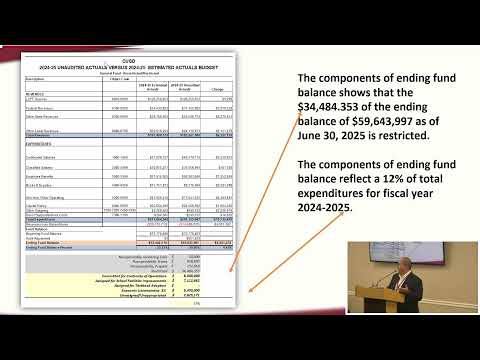
The presenter said the district had expected an ending fund balance of about $19 million but finished closer to $26 million, a difference he described as "a really good thing for us." He attributed the improvement chiefly to lower-than-expected expenditures (about $2 million) and payroll savings tied to vacancies and extra-duty positions, plus recognition of roughly $7 million less revenue this year that will carry over into the next fiscal year.
The presenter cautioned trustees that the improved balance does not eliminate structural budget pressures. "We are still deficit spending," he said, and reminded the board that California funds districts on average daily attendance; when students do not attend, the district's revenue is directly affected. He added that Calexico Unified likely has a larger gap between enrollment and average daily attendance than many districts and that staff, teachers and the community are working to improve student connectedness and attendance.
On restricted accounts, the presenter said actuals were close to estimates and noted an improved restricted ending balance of about $561,000. He emphasized that restricted funds come with specific allowable uses and generally cannot be repurposed for general-fund needs.
Board member Mr. Himemen raised a transcription/formatting correction on the record, saying the ending fund balance figure should be written as "34,484,353" with commas rather than a decimal. The presenter acknowledged the correction.
Looking ahead, the presenter reviewed a revised 2025–26 budget that starts from the improved beginning balance but reiterated that much of the apparent improvement reflects timing and one-time carryover revenue, not recurring revenue increases. He thanked coordinators and administrators who pursue grants that bring large, sometimes one-time funding streams to the district.
The review included these summarized figures as presented: an improved ending general balance (projected $19 million, actual about $26 million), a decrease in projected expenditures of a little over $2 million, reduced general-fund contributions to restricted funds of about $1.135 million, approximately $7 million of revenue recognized later (deferred), and an improved restricted ending balance near $561,000. The board discussion that followed focused on monitoring attendance-driven revenue and on maintaining cautious budgeting assumptions. The meeting moved next to the revised 2025–26 budget review.