Get Full Government Meeting Transcripts, Videos, & Alerts Forever!
Get email alerts on the Mobility Fee topic
No spam. Unsubscribe anytime.
Lake City council reviews proposed mobility plan and one-time development fee
Summary
Lake City held an April 6 workshop on a proposed 24-year mobility plan and a one-time mobility fee on new development intended to fund multimodal projects; staff outlined a roughly $500 million plan with about $137 million attributable to the city and sought council direction on waivers and phased implementation.
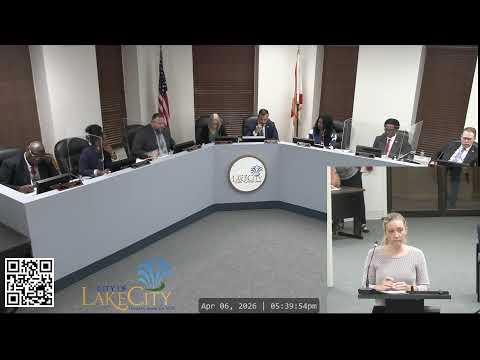
Lauren Rushing, transportation planner with New Urban Concepts, told the Lake City Council at a workshop on April 6 that the city is considering a mobility plan and a one-time mitigation fee on new development to fund a connected multimodal transportation system through 2050.
"This is a fee that is not a tax on existing residents, it's not an assessment on existing homes, it's a fee that's paid by new development only," Rushing said as she explained that the fee would apply to new growth and is assessed one time at building permit.
The mobility plan is organized into three subplans — streets, trails and greenways, and intersections — and covers projects on city, county and state roads that affect Lake City travel. Rushing presented planning-level cost estimates totaling roughly $500 million; she said about $369 million of that is expected to come from county, state or other funding, leaving an attributable city cost of about $137 million over the 24-year planning horizon.
Rushing summarized the draft ordinance and technical report that would amend the city's code by adding Article 6 (mobility fees) under Chapter 86 (streets, sidewalks and public spaces). The ordinance would require a comp-plan amendment within a year of adoption, per Florida statute, to remove conflicting transportation-concurrency language.
Key design features discussed include a single assessment area across the city (so developers pay the same rate citywide), a benefit-district requirement and a rational-nexus test to ensure fee revenues are spent on projects that benefit paying developments. The draft ordinance also includes a refund provision: "if mobility fees are not spent within 7 years, you have to refund them back to the applicant," Rushing said.
Rushing described the fee methodology: the attributable project costs are divided by added person-capacity and adjusted by trip-generation rates to produce per-land-use rates. Examples presented: a 1,500-square-foot single-family home would be charged $1.77 per square foot (a one-time fee of $2,655); a 4,000-square-foot convenience retail building with a drive-thru (example given as a McDonald's) could be charged roughly $13.26 per square foot plus per-lane fees (Rushing cited an illustrative per-lane figure of $20,000), producing an example fee on the order of $73,000.
Rushing said the schedule incorporates a "local retail" category that charges local small businesses half the multi-tenant retail rate to encourage economic development; Florida statute also allows exemptions or discounts for affordable housing and economic-development initiatives, she said.
On applicability, Rushing clarified the fee would be assessed at the point of building permit and would apply to developments permitted 90 days after adoption; projects already approved at adoption would not be charged. For change-of-use cases, the draft treats the fee as the difference between the new and prior use unless the original use has been vacant for more than three years, in which case the full fee applies.
City staff sought direction from council on two policy choices: whether to include a formal waiver path (for example, to waive fees in return for significant local job creation) and whether to phase in the fee (a four-year ramp of 25 percent increases each year) rather than begin collecting the full rate immediately. Robert Angelo, who introduced the consultant and later led the ordinance-discussion segment, outlined those options and asked the council for guidance on drafting.
City Manager Rosenthal said the manager's office recommended council discretion to waive fees in particular cases and supported staggered implementation. City Attorney Martin cautioned that broad waiver or exemption authority can raise constitutional equal-protection concerns and asked for time to work with consultants and staff; he recommended potentially delaying the second reading to allow legal review and circulation of revised language.
Councilmembers voiced a mix of caution and support. Councilmember Carter said he favored adopting the plan while protecting families and small additions to existing homes from undue burden, and he urged clear short- and medium-term project priorities so residents can see progress. Several councilmembers said they want the power to make exceptions for major economic-development opportunities.
Mayor Walker noted there were no public-comment cards submitted, so the workshop concluded with council discussion and no public comment segment. Staff indicated the draft ordinance is scheduled for first reading on April 20, 2026, and staff will return with refined ordinance language after council direction and legal review.
Next steps: staff will draft ordinance language reflecting council direction on waivers and phase-in options, the city attorney will review language for potential legal risk, and the first reading is scheduled April 20, with additional readings and comp-plan amendment timing to follow if council pursues adoption.