Get email alerts on the Land Use Signs topic
No spam. Unsubscribe anytime.
Commission backs countywide 'master sign plan' rules for very large developments
Summary
The planning commission voted to forward a countywide sign‑code amendment creating an administrative 'master sign plan' process for unified large‑scale developments of at least 2,000 acres, while commissioners urged tighter lighting and waiver limits; staff recommended approval and noted a 15 business‑day administrative review window.
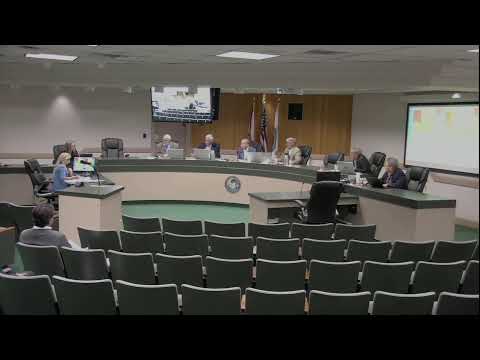
The Clay County Planning Commission on April 7 recommended that the Board of County Commissioners advance a proposed sign‑code amendment that would allow developers of very large, multi‑phase projects to submit a single, county‑approved master sign plan governing monument, gateway and directional signage across a unified area.
The proposal and purpose: Staff described Z26‑00006 as a two‑part change: modest zoning changes specific to Lake Asbury and a broader revision to the county’s sign code that creates a ‘master sign plan’ and a new definition, ‘unified large‑scale development,’ intended for projects of not less than 2,000 acres. The plan would let applicants map sign locations, submit design standards and show evidence of unified control (ownership, lease or recorded agreement).
Applicant perspective: Frank Miller, the applicant’s representative, said the master sign plan concept was proposed to produce a cohesive look for very large developments such as Saratoga Springs and to avoid visually inconsistent signage. “Because it’s such a large project … for their benefit, for the benefit of the community … to have a sign plan concept that has a unique cohesive, coordinated signage for the whole project is a benefit to everybody,” he said.
Key provisions and concerns raised: The ordinance would allow directional signs in the right of way (with spacing and text limits) and gateway feature signs; it creates an administrative approval path with limited waivers (10–15% depending on sign type), requires the master sign plan to run with the land, and requires out‑of‑plan signs to be brought into compliance or removed within 180 days. Staff noted a 15 business‑day timeline to complete an administrative review. Commissioners and members of the public raised specific concerns about lighting standards, the 15‑business‑day review window for complex plans, how waivers would be limited in practice, and enforcement capacity for long‑term compliance.
Outcome: After questions and minor clerical edits recommended by staff and legal, the commission voted to forward the ordinance (article 3 and article 7 changes) as recommended by staff so the Board of County Commissioners can consider the item at its April 28 meeting. Staff said the Lake Asbury Citizens Advisory Committee and other local advisory groups will weigh in at upcoming meetings as part of the record.
What this does and does not do: The change creates an optional developer‑initiated pathway for very large projects to adopt a coordinated signage regime; it does not automatically change signs on existing development unless an applicant chooses the master sign plan route.
AI generated
The text on this page is AI generated. Summaries, highlights, analysis, and video transcripts are all produced from the original source material.
AI can make mistakes, so if you spot one, and we will fix it for everyone.
Note: the source content is unaltered by us. Any content source we link to, be it a video, an audio recording, or a document, is presented exactly as its publisher released it. That publisher is usually a government body, sometimes an individual official or another organisation.