Get Full Government Meeting Transcripts, Videos, & Alerts Forever!
Get email alerts on the Agriculture And Environment topic
No spam. Unsubscribe anytime.
Poultry-house variances prompt questions about setbacks and future expansion at Madison County hearing
Summary
Multiple applicants asked to rezone land to A1 and seek variances for poultry-house setbacks; commissioners pressed applicants to justify deficits (some over 100 feet), and staff reported neighbor opposition concerned that rezoning could enable future poultry development without additional hearings.
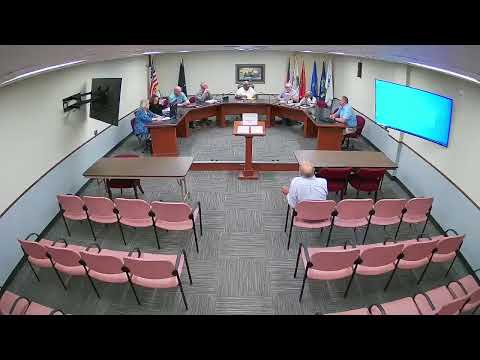
Several agenda items before the Madison County Planning & Zoning body centered on requests to rezone parcels to A1 and to grant variances so poultry houses could be built closer to property lines or dwellings than the ordinance normally allows. Commissioners repeatedly asked applicants to explain why variances were needed and whether topography or other hardship criteria applied.
Kenneth Hong asked to rezone 34.79 acres from A2 to A1 to build four poultry houses and requested a variance because one proposed poultry house would be about 200 feet from a side property line with deficit distances reported as roughly 97.2 feet and 97.4 feet in two corners. Commissioners asked for clearer justification for the variance rather than an explanation that it would be cheaper to build on a pre-graded pad.
Staff also read other poultry-related variance requests: Brian Martin’s application for an additional poultry house cited setbacks with deficits of about 122 feet and 134 feet; Gary Harbin (on behalf of Ralph McKay Jr.) sought a variance to build on a graded pad from decades earlier that fails the 300-foot setback in several places; and Cody and Carrie Threel asked to replace a damaged poultry house and reported multiple setback deficits, including a roughly 105.21-foot deficit relative to a surrounding dwelling whose owner (the applicant’s father-in-law) reportedly offered no objection.
Miss Patrick reported at least one neighbor concern: "A neighbor, Tommy Hunter, reached out and was very, very upset that rezoning could permit poultry houses in the future without having to go before the board," she said. Commissioners discussed whether the applicant’s choice to rezone adjacent parcels together would permit future expansion without an additional hearing if setback requirements are met, and whether conditions could be attached to approvals to limit expansion.
Commissioners emphasized ordinance standards and public-safety considerations: shared-drive/access concerns were raised when easements or driveway configurations would affect emergency response and road-safety. Several applicants were asked to supply more information and to appear at the April 21 public hearing with evidence that they meet variance criteria outlined in Chapter 11 of the zoning ordinance.
No variances or rezones were approved at the meeting; applications were placed on the public-hearing docket for April 21, 2026, and the Board of Commissioners will render final decisions after those hearings.