Get Full Government Meeting Transcripts, Videos, & Alerts Forever!
Get email alerts on the Land Use topic
No spam. Unsubscribe anytime.
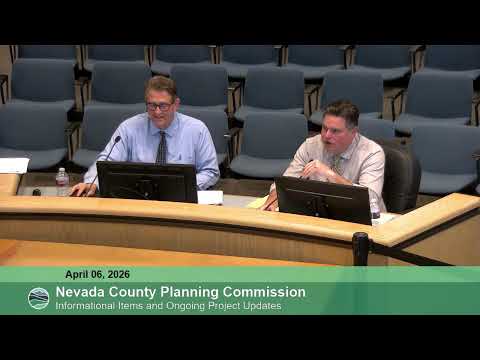
Nevada County planning commission sends ‘Hidden Grove’ mixed-use project to supervisors after split votes and heated public comment
Summary
The Nevada County Planning Commission voted April 6 to recommend approval of the Hidden Grove mixed-use project (a general plan amendment, rezoning, use permit, parcel map, management plan and road exception) and forwarded the items to the Board of Supervisors after extended public comment and technical questions about traffic, septic systems and compatibility.
The Nevada County Planning Commission voted April 6 to recommend that the Board of Supervisors approve a package of actions that together would authorize “Hidden Grove,” a proposed 3.31-acre mixed-use development on State Highway 174 in the Cedar Ridge area.
The package includes a general plan amendment to add a business-park designation, a rezoning to Business Park Site Performance, a comprehensive master plan and use permit for three two-story mixed-use buildings (a total of 15 residential units and nine light-industrial suites), a tentative parcel map to create four lots, a management plan allowing removal of one landmark California black oak (mitigated by replanting), and an exception to road-right-of-way standards for Hobart Lane. The commission also adopted a mitigated negative declaration and mitigation monitoring program under CEQA.
Why it matters: The proposal combines workforce-style housing and small-business workspace in a compact live-work concept aimed at keeping entrepreneurs in Nevada County. Neighbors said the project would change the rural character of Cedar Ridge, worsen traffic on Highway 174 and risk groundwater and evacuation capacity. The commission’s recommendation now moves the matter to the Board of Supervisors, which will make the final decisions.
What the commission decided - The commission adopted the environmental finding (mitigated negative declaration) unanimously. - The legislative items that change the general plan and zoning were recommended to the board by 2–1 votes (Commissioners Foley and Garst voting yes; Vice Chair McAteer voting no). The use permit/comprehensive master plan also passed on a 2–1 vote. The tentative parcel map and the management plan (oak removal mitigation) passed unanimously. The petition for exception to road-right-of-way standards was approved and will be subject to conditions including strip easements.
Project details and conditions Steve Guyger, senior planner, described the proposal as a phased, four-phase project at 12647 State Highway 174: phase one would regularize the existing home-based Sereno’s Bloody Mary mix operation, establish a storage/maintenance yard, and subsequent phases would construct three mixed-use buildings containing three light-industrial suites and five residential units apiece. The project requests a density bonus (one very-low-income, deed-restricted unit) that increases residential capacity from 13 to 16 units under state law. Parking is shown for 49 spaces, water service would be supplied by Nevada Irrigation District, and wastewater would be handled by three clustered septic systems subject to Nevada County Environmental Health design and annual monitoring.
Mitigations described in staff reports include two 8-foot sound walls along eastern parking edges, operating-hour limits for industrial suites (restricted to 7 a.m.–10 p.m.), roll-up doors closed at night, final lighting plans to avoid spillover, traffic mitigation to widen a center turn lane on Highway 174 per Caltrans recommendation, a mitigation and monitoring plan for the removed oak (acorn replanting), and conditions on road improvements for Hobart Lane (construction to a 24-foot A1 section with 5-ft and 15-ft strip easements required on either side).
Applicant’s case and supporters Theo Goodman, the applicant’s representative, and applicant Jerry Serero framed Hidden Grove as a live-work incubator designed for small-scale manufacturing, workshops and storage (examples included engraving, signmaking, small assembly, and contractor storage). Serero appealed to commissioners on historical and community grounds and said the project would help retain young families and entrepreneurs in Nevada County. Supporters in the audience — including former supervisor Ed Scoffield and small-business advocates — said Hidden Grove would provide needed workforce housing and space for startups.
Neighbors’ concerns and staff replies More than two hours of public comment produced a long record of opposition and support. Opponents said the proposal would expand the Cedar Ridge rural center boundary, contradict general plan rural-character policies (notably policy 1.3.6, which staff noted sets a 10% guideline for business-park uses in a rural center but allows variation), reduce setbacks dramatically (requested reductions from 30 feet to five feet), and pose wildfire evacuation, noise, groundwater/septic and traffic safety risks at the nearby intersections on Highway 174. Several locals said they received notice only after the environmental document was circulated and expressed frustration with the timing of formal notice.
Staff clarified that the county mailed notice to property owners within 300 feet when the environmental document was released and that the applicant had previously been encouraged to meet neighbors during application processing. Environmental Health explained clustered septic systems would be designed with setbacks and modern pre-treatment and required annual maintenance and monitoring contracts. The county’s traffic consultant found the project would not degrade two of three studied intersections below the county’s standard but required Caltrans’ recommended turn-lane improvements at the Brunswick Road intersection.
Key quotes - Opponent: “This is in direct violation of county code … This site is just completely unsuitable,” said a Cedar Ridge resident who questioned compatibility with the general plan. - Applicant: “This project is designed to incubate small businesses and allow people to live where they work,” said applicant Jerry Serero.
Next steps The commission forwarded its recommendations, findings and mitigation measures to the Board of Supervisors; staff indicated the items are likely to be scheduled for a board hearing in the coming month or two. Any final approvals by the board will carry the conditions and mitigation monitoring program adopted by the commission.
Votes at a glance - Mitigated Negative Declaration (CEQA): Approved (3–0) - General Plan amendment (GPA24-00001): Recommended to Board (2–1) - Zoning map amendment (RZN24-00001): Recommended to Board (2–1) - Use permit / comprehensive master plan (UP24-00001): Recommended to Board (2–1) - Tentative parcel map (TPM24-00001): Recommended to Board (3–0) - Management plan to remove landmark oak (MP24-00001): Recommended to Board (3–0) - Petition for exception to road standards (EXC24-00001): Recommended to Board with conditions (3–0)
What to watch The Board of Supervisors will consider the commission’s recommendations and the mitigation monitoring program; opponents asked the board to weigh rural-character policies, traffic/evacuation risks and septic/well impacts carefully. Supporters urged the board to prioritize workforce housing and small-business retention.
(For a summary of the evidence in the public record and the staff report, see the planning department’s project file.)