Get Full Government Meeting Transcripts, Videos, & Alerts Forever!
Get email alerts on the Corporate Expenses topic
No spam. Unsubscribe anytime.
Hazardville urges PURA to revisit disallowances on executive fees and profit-sharing; commissioners press storm-cost and reopener rules
Summary
Hazardville Water asked the Public Utilities Regulatory Authority to reconsider partial disallowances for directors-and-officers insurance, board fees and profit sharing and sought an express limited-reopener authorization; commissioners and the Office of Consumer Counsel said record justification is required and that overtime—not base payroll—is the usual basis for storm-cost deferrals.
Hazardville Water Company asked the Public Utilities Regulatory Authority to reconsider partial disallowances in the draft decision for directors-and-officers (D&O) insurance, board-of-director fees and profit-sharing payments, arguing precedent and the company’s small size support a smaller disallowance.
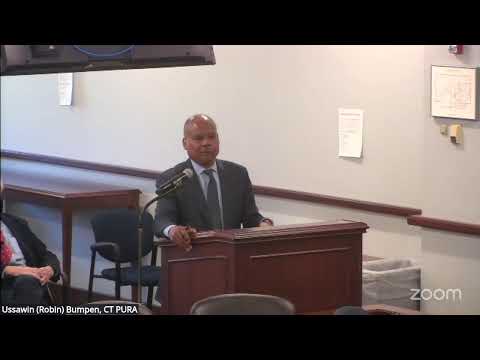
Attorney Boen told the panel the company’s profit-sharing program can align with ratepayer benefits when it is tied to operational metrics, and that it “had elements of PBR” (performance-based components) such as reductions in non-revenue water. Boen said a blanket disallowance risks discouraging practices that can yield ratepayer benefits and noted the company sometimes did not pay profit sharing when goals were unmet.
The Office of Consumer Counsel and PURA staff said these items are primarily shareholder-oriented and supported partial disallowances in the proposed decision, citing precedent and the need for demonstrable customer benefit. OCC said the company raised a new chair position and associated salary since the last rate case without sufficient justification for recovery.
On storm-related payroll, commissioners reiterated the standard regulatory practice: overtime (incremental pay beyond amounts built into base rates) is typically the recoverable element to avoid double recovery of regular salaries. The company said some storm work was booked to overtime and some was not, and commissioners asked the company to identify overtime amounts in the record if it seeks deferred storm-cost recovery.
Finally, the company asked PURA to adopt express language authorizing limited reopeners for discrete capital projects to avoid full new rate cases; commissioners acknowledged limited reopeners are sometimes appropriate for small water companies but stressed that such requests raise single-issue ratemaking concerns and should be narrowly defined. The company said the project at issue includes soil remediation and is scheduled for completion in 2028.