Get Full Government Meeting Transcripts, Videos, & Alerts Forever!
Get email alerts on the Early Childhood Funding topic
No spam. Unsubscribe anytime.
Buncombe County committee debates funding scenarios for early-childhood grants, asks staff to clarify YWCA request
Summary
Committee members reviewed ranked applications and three funding scenarios for the county—s early-childhood investment pool, debated formulaic cuts versus line-item reallocations, flagged a discrepancy in the YWCA—s requested amount, and agreed to schedule a follow-up meeting to finalize awards.
Buncombe County committee members spent the meeting reviewing ranked grant applications and comparing three funding scenarios for the county—s early-childhood investment pool, ultimately asking staff to clarify applicant budgets and scheduling a follow-up meeting to finish allocations.
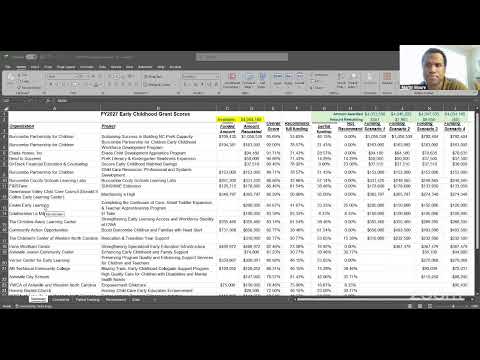
The meeting opened with staff demonstrating a spreadsheet that models different funding options: (1) fund top-ranked projects until the money runs out; (2) fund projects with >50% recommendation at the requested amount and give others 75% of their request; and (3) fund projects meeting a 75% recommendation threshold while giving others 75% (Angeline, staff). Committee members asked Angeline to display the variants so they could compare how many organizations would receive full or partial awards under each scenario.
Several members urged conservatism about changing application material. "We really can't move the needle for the applications that have already been submitted," one facilitator said, urging the committee to stay true to the metrics it set for this cycle. Staff (Rachel) and members agreed to capture ideas for future process changes without altering the current round—s standards.
The group debated whether to prioritize overall score rankings or the percentage of reviewers recommending full funding. Dr. Sandler and others said scenario three (which stretches funds to more organizations through partial awards) appeared to include more programs that merit discussion. "I like scenario three as a sort of starting point," Dr. Sandler said.
Members raised program-specific concerns that could affect funding decisions. Several speakers urged careful review of the Children—s Center of Western North Carolina—s relocation plan and finances after members noted the center faces a mortgage and will reduce enrollment when it moves. "I'm concerned about their ability to stay open once they move," one member said, noting the center would drop from 60 to 50 slots and face renovation costs. Members also discussed centers with incomplete budgets and argued for extra technical assistance for smaller organizations that may lack grant-writing capacity.
Staff and committee members discovered a data discrepancy in one borderline application: the YWCA's request field in the software showed $150,000 while the organization—s submitted budget form summed to $100,000. Angeline said the budget sheet appears to reflect $100,000 and that the higher number may be a data-entry or software error. Members asked staff to contact the YWCA and clarify the correct ask before any final vote.
Committee members also discussed formulaic adjustments to free funds (for example, small percent reductions applied across funded awards or targeted reductions for applicants with a high "not recommended" percentage). One suggestion that gained traction was modeling a modest percentage reduction for applicants with 20% or higher "not recommended" marks to see whether that would fund borderline applicants without abandoning the ranked process.
The meeting included procedural debate over whether to approve one scenario now or continue deliberations. After confusion about a proposed vote to lock in a particular scenario, Martin (facilitator) withdrew the ambiguous motion and instead moved to schedule a follow-up meeting next week so the group could finish the allocations with clearer staff data. The motion to convene a follow-up meeting was seconded and supported; staff will poll members for a time and contact applicants only through staff channels to respect the committee—s no-contact rule.
Next steps: staff will (1) contact the YWCA to confirm the correct funding ask and clarify any budget omissions; (2) add any requested scenario columns to the shared spreadsheet and re-run the numbers; and (3) send a poll to schedule a follow-up meeting next week to conclude award decisions. The committee paused final allocations pending those clarifications.