Get Full Government Meeting Transcripts, Videos, & Alerts Forever!
Get email alerts on the Budget topic
No spam. Unsubscribe anytime.
Commission reviews cash‑flow model, county investment return and long‑term sustainability for CRF
Summary
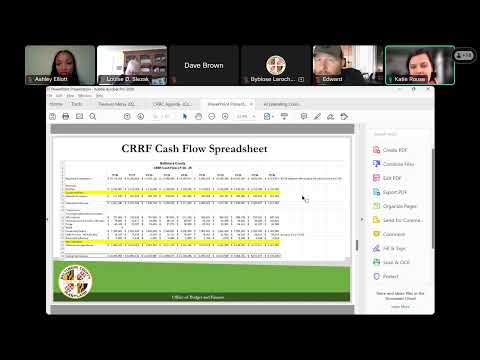
Commission staff presented an interactive cash‑flow spreadsheet modeling conversion fees and county investment returns (illustrative 3%) and discussed funding for ongoing commitments and a proposed grant‑processing staff position; commissioners pressed for clarity on account types, revenue volatility and state distribution rules.
Commission staff walked the commission through an interactive cash‑flow spreadsheet intended to test how Community Reinvestment Fund balances, conversion‑fee revenue and county investment returns would support both ongoing commitments and new initiatives.
A staff member identified as Matt explained the tool’s mechanics and assumptions, including a “wildcard” line for volatile conversion fees and an illustrative 3% interest estimate to reflect county investment returns. He said the spreadsheet is plug‑and‑play so commissioners can model different new initiatives against balances and see when funds might run low.
Matt noted current lines baked into forecasts include previously approved items such as freezing‑weather shelter support and a homeless‑coordinator position, and recommended adding a new, part‑time staff role to support grant agreements, invoice processing and program monitoring once applications are received. “I was the one who put this together for you guys,” he told the commission, explaining the design choices.
Commissioners pressed about where the funds sit and the risk profile. The presenter said CRF balances are part of county cash that is swept into county investment pools and that the fund will receive the county rate of return; he described the 3% figure as illustrative and said staff will consult the county investment manager for precise projections. On whether the revenue share is fixed, staff said distribution percentages are set at the state level and can change only if the state amends statutes; locally, the county receives a small administrative deduction before allocation to the fund.
Members also asked whether unspent CRF dollars are swept at fiscal close; staff clarified the CRF is coded as a special fund that carries over year to year and is not automatically swept into the general fund without code changes.
The commission directed commissioners to schedule subcommittee meetings between April 16 and 23 to review scored applications after the April 1 deadline and to return recommendations to the full commission on April 23. No formal action on the cash‑flow model was taken at this meeting.