Get Full Government Meeting Transcripts, Videos, & Alerts Forever!
Get email alerts on the Assessment Policy topic
No spam. Unsubscribe anytime.
Classic Learning Test supporters tell committee CLT offers an alternative to SAT/ACT; lawmakers press for concordance and predictive data
Summary
Proponents of House Bill 326 told the Senate Education Committee the Classic Learning Test (CLT) provides an alternative college-admissions exam aligned with classical curricula and cited concordance and predictive validity studies; committee members requested score concordances and predictive-value data and asked whether the CLT is sufficiently comparable to ACT/SAT.
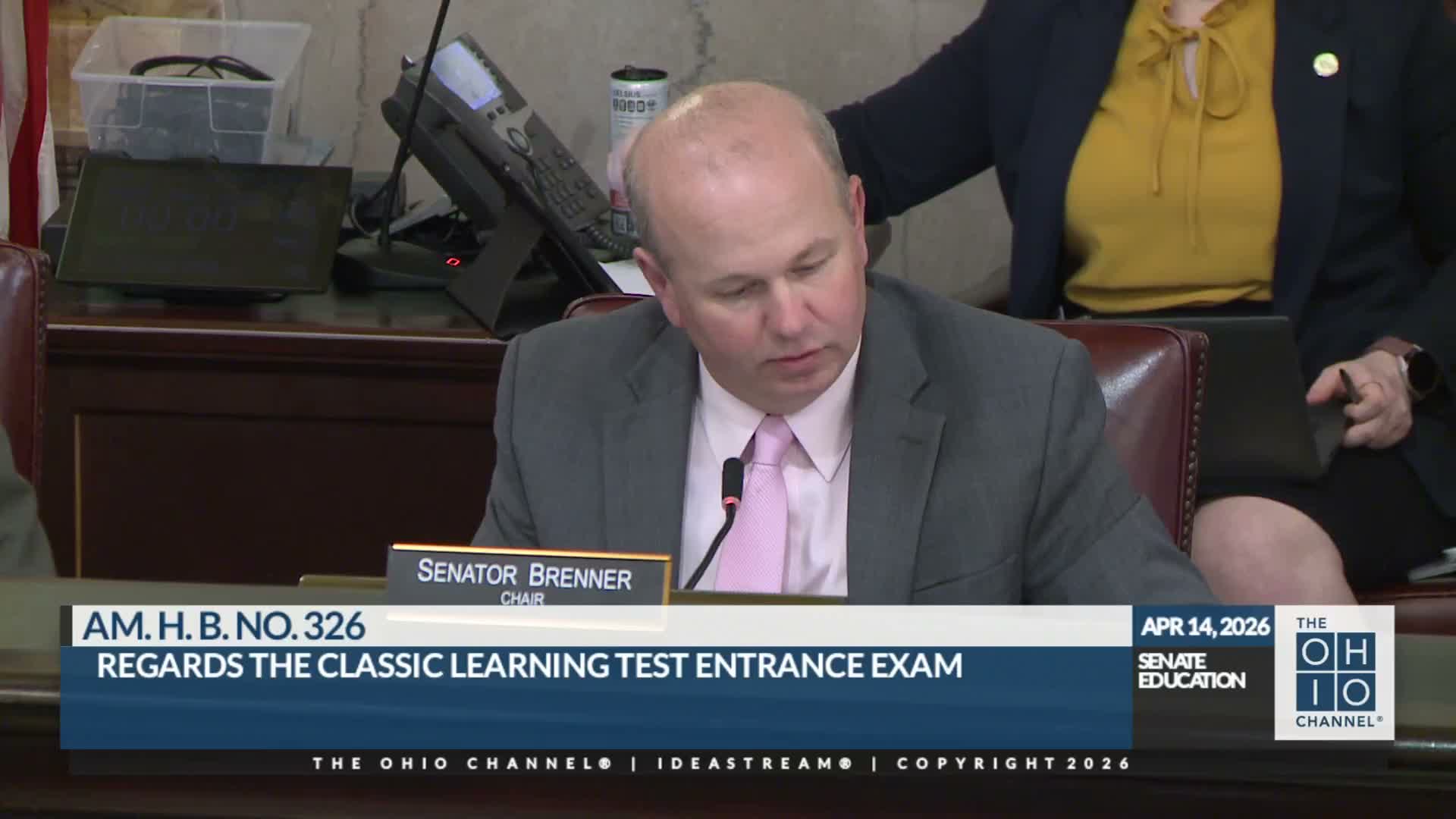
Supporters of House Bill 326, which would make the Classic Learning Test an optional college-entrance exam in Ohio, told the Senate Education Committee the CLT is an alternative to the SAT and ACT that many colleges now accept. Michael Torres, policy director at Classic Learning Initiatives, said the CLT administered nearly 200,000 tests last year and partners with about 340 colleges and universities. "Our concordance study has been used with 0 issues by all 340 of our colleges," Torres said, and he referenced multiple predictive validity studies that, he said, show the CLT is as predictive of first-year college GPA as the SAT.
Committee members asked for the underlying studies and concordance charts. Senator Smith asked specifically for numeric alignments between CLT scores and SAT/ACT scores and for predictive-value numbers; Torres said the studies exist on the company's website and in the submitted written testimony but that he did not have the numeric charts in hand during his oral testimony.
Nathaniel Beckman and Rocco Galizio, representing Chesterton Academy campuses, testified they have used the CLT for years and find the test aligns well with classical curricula and longer reading passages that they value. Galizio described the CLT scoring scale as 1–120 across three 40-point sections and said the test provides a "crosswalk" to help schools and colleges compare CLT results to SAT scores.
Lawmakers pressed on logistics: who scores the test (Torres said CLT company scores it, similar to how SATs are processed) and whether local schools that use CLT also send students to take SAT/ACT for broader college options. Witnesses said many students still take the SAT or ACT depending on college requirements.
The committee recorded the testimony and requested documentation of the concordance and predictive-validity work; no committee vote was taken at the conclusion of the testimony.