Get Full Government Meeting Transcripts, Videos, & Alerts Forever!
Get email alerts on the Podiatry Compact topic
No spam. Unsubscribe anytime.
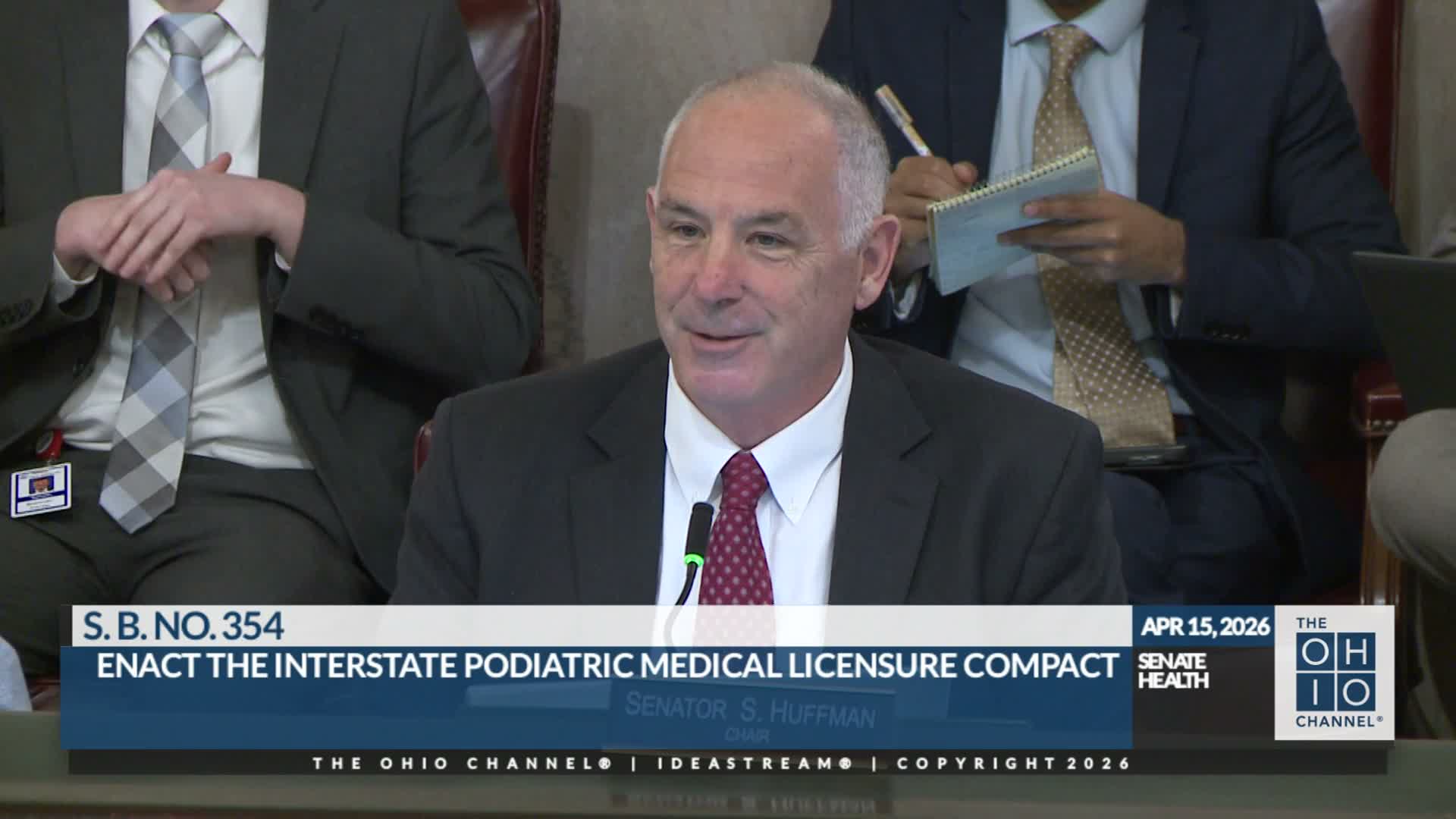
Proponent says podiatry compact will speed multistate licensure while preserving Ohio authority
Summary
A proponent told the Senate Health Committee that Senate Bill 354 would join Ohio to an interstate compact for podiatric physicians to speed multistate licensure, while the committee probed how differing state scopes would be reconciled and whether compact licenses translate into in‑state practice.
A sponsor/proponent (S3) described Senate Bill 354 as a mechanism to join the Interstate Podiatric Medical Licensure Compact and create a faster pathway for qualified podiatric physicians to obtain licensure in multiple states.
S3 said the compact functions as a contract between states that preserves Ohio's authority over licensure, regulation and discipline. "The compact simply creates an additional expedited pathway for qualified professionals to obtain licenses in multiple states," S3 said, adding that compact membership reduces administrative burdens and helps rural and military families access care.
Committee members asked whether varying scopes of practice and licensing board structures among states would cause difficulty for clinicians moving across jurisdictions. S7 noted differences among states in scope—some include ankles, some only toes—and asked how the compact would reconcile those variations. The proponent replied Ohio retains regulatory authority and the compact commission would help work through differences; practitioners would only be allowed to practice within what they are trained to do under Ohio's standards.
Members also asked whether compact licensure necessarily produces in‑state practice. S3 and S4 said a compact license requires a state‑specific compact credential and places the practitioner under Ohio jurisdiction when they practice in Ohio, but compact status cannot compel clinicians to relocate to underserved areas.
The committee concluded the first hearing after members asked for staff follow‑up on technical questions and possible conforming language updates.