Get Full Government Meeting Transcripts, Videos, & Alerts Forever!
Get email alerts on the Capital Needs topic
No spam. Unsubscribe anytime.
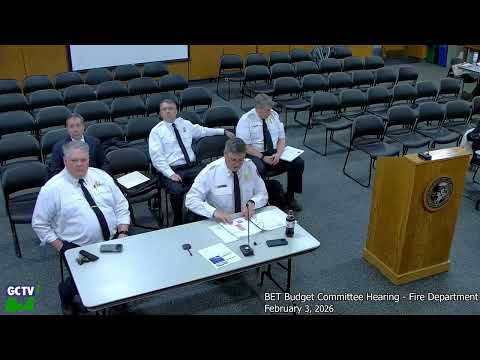
Greenwich fire department flags aging fleet, slow supply chains and seeks capital for tankers, SCBAs and alerting
Summary
Officials told the committee multiple engines and ladder trucks are past their mid‑life, the department faces a backlog of >160 open work orders and manufacturers' lead times push replacement schedules years out; the department requested capital lines for SCBAs, hose replacement, volunteer tankers and a cloud‑based firefighter alerting upgrade.
Fire department leaders presented a multi‑year capital outlook that emphasizes aging apparatus, deferred maintenance and equipment modernization needs.
Chief McHugh said two 20‑year‑old engines, two 25‑year‑old ladder trucks and other support vehicles have reached levels of wear that require significant repairs or replacement; repair costs climb sharply after a vehicle’s tenth year. The department is using a loaner engine from Stamford and reported more than 160 open fleet work orders, which often require outsourcing to distant vendors and add transport and overtime costs.
On specific capital requests, the department outlined: a multi‑year $25,000 program to replace aging fire hose in staged intervals; a year‑two request to replace self‑contained breathing apparatus (SCBAs) and bottles and to adopt packs with location/tracking features (staff said current SCBAs are ~15 years old and maintenance for the fleet approaches $20–25k annually); and a capital placeholder for volunteer tankers (the packet used $1,000,000 as a conservative figure to allow for price escalation). Staff estimated tanker lead times around 36 months from order to delivery.
Staff also urged replacing an end‑of‑life Zetron alerting system with a cloud‑based, cellular‑redundant platform that supports P25 encryption and consolidates vendor services; the existing system is roughly 15 years old and repairs have cost more than $25,000 this year. Committee members asked for updated CIP sheets and clarified ownership and maintenance arrangements for volunteer companies’ equipment when town funds are used.
No formal vote was taken. Committee members requested revised CIP documentation and clarifications on asset ownership and maintenance commitments before approving capital recommendations.