Get Full Government Meeting Transcripts, Videos, & Alerts Forever!
Get email alerts on the Labor Contracts topic
No spam. Unsubscribe anytime.
Oak Grove educators press for higher pay, better benefits and expanded special-ed staffing as bargaining opens
Summary
Teachers and union representatives used a public hearing Dec. 12 to press the Oak Grove School District for higher pay, relief from rising health-care costs, fewer contracted special‑education providers and safety measures. Bargaining begins in January; the board took no immediate action on demands.
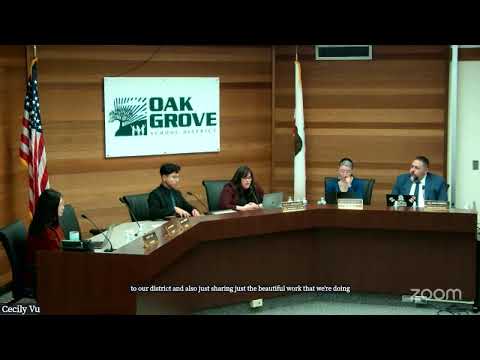
At a Dec. 12 public hearing, teachers and Oak Grove Educators Association members urged the school board to address salaries, benefits and special‑education staffing ahead of contract talks beginning in January.
Speakers at the hearing said rising health‑benefit costs and low local salaries are driving staff to other districts. “Something's got to be done about salaries,” said Bob Pra, representing Oak Grove educators, who said health‑care changes in January will cut teachers' monthly pay and that the union will press for benefit redesigns that protect employees when Kaiser raises rates.
Union members and teachers also focused on special education. “We cannot attract and retain special educators,” Pra said, noting the district relies on more than a dozen contractors to fill roles. Sair Gavara, an ethnic‑studies teacher and bargaining‑team member, said the team will bring proposals to reduce contracted positions and improve retention. “We want the same opportunities as neighboring districts,” Gavara said.
Multiple speakers described large caseloads for related‑services staff. A speech‑language clinician and other special‑education staffers told the board that typical caseload language (a cited 60‑student average) is untenable and that staff need release time to complete paperwork. “If you want effective services, give us time during contracted hours so we don't have to do paperwork on weekends,” said Lisa Amador, an autism teacher at Davis.
Commenters also called for low‑cost safety measures for classrooms and increased, direct mental‑health supports for staff. One speaker described previously free mental‑health services that are now charged to employees and asked the district to restore robust, accessible support.
The board opened and closed the bargaining public hearings and did not act on contract demands at the meeting. Several trustees and administrators acknowledged the concerns and noted negotiations with the bargaining units will start in January. No formal motions were made to change bargaining positions; the hearing served to register priorities that union leaders said they will take to the table.
The board's public‑comment period also included a speaker urging the district to provide Spanish‑language math textbooks to newly arrived students so they can access math while still learning English.
What happens next: Bargaining is scheduled to begin in January. Union leaders said they will present proposals addressing (1) wages and benefits, (2) limits on contractor use in special education, (3) caseload and paperwork time for related‑services staff, and (4) classroom safety and mental‑health support for employees.