Get Full Government Meeting Transcripts, Videos, & Alerts Forever!
Get email alerts on the School Wellness topic
No spam. Unsubscribe anytime.
Montgomery County outlines expansion of school wellness centers and mental‑health spaces in CIP update
Summary
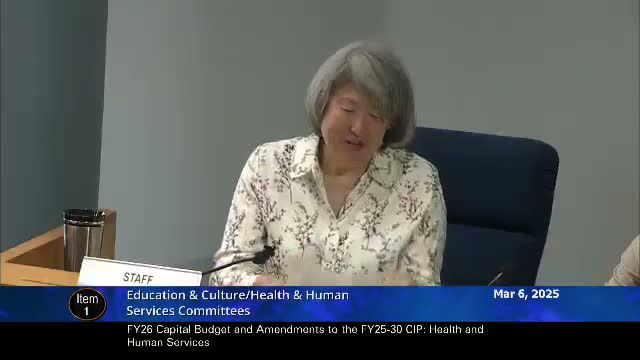
County staff updated the joint Health & Human Services and Education & Culture committees on existing and planned school‑based wellness centers and mental‑health/PYD spaces, noting six high schools already have full centers and funding for three additional comprehensive centers in the FY25–30 CIP.
Montgomery County staff told a joint session of the Health & Human Services and Education & Culture committees that the county is advancing school‑based wellness centers and mental‑health spaces across the public high‑school system, with both capital and program considerations driving the work.
Council staff summarized the inventory and pipeline: six high schools currently have comprehensive wellness centers—Gaithersburg, Kennedy, Northwood, Seneca Valley, Watkins Mill and Wheaton. The approved FY25–30 CIP includes funding for three additional comprehensive wellness centers: Springbrook (programmed for FY26), Paint Branch (programmed for FY28) and a project at Woodward to accommodate Northwood students (program beginning FY26). The CIP also includes funding for mental‑health and positive‑youth‑development (PYD) spaces at Blake (program beginning FY28), McGruder (FY29) and Crown (FY25).
Mark Hodge, chief operating officer for HHS, emphasized the operational challenge of turning physical space into delivered services: "Opening up to them and having them actually show up, are two different things," he said, noting options such as opening existing elementary school‑based health centers to students from other schools and piloting telehealth or rotating (cluster) models as short‑term measures.
DJ Connolly, MCPS capital budget manager, said MCPS looks forward to continued collaboration with HHS and affirmed the district’s willingness to be creative about program footprints and construction timing. Dr. Bridgers (HHS) said the county has prioritized equity and mental‑health linkages and that program planning, parental engagement and implementation resources must accompany capital investments.
Committee members asked staff to pair capital planning with programmatic outreach and tracking so families who need services actually use them, and to consider middle‑school access as CIP priorities are revisited. Staff said some solutions—such as using a classroom for a "bridge to wellness" program or rotating part‑time clinic presence across middle schools—could provide interim access while larger projects proceed.
What it means: The CIP updates commit capital dollars for both facility build‑outs and mental‑health spaces, while staff and committee members signaled that program design, staffing and outreach will determine whether increased capacity translates into service use.
Next steps: Staff will continue coordination with MCPS and HHS program leads and will report back on implementation options and service models as the full CIP is developed.