Get Full Government Meeting Transcripts, Videos, & Alerts Forever!
Get email alerts on the Glyphosate Policy topic
No spam. Unsubscribe anytime.
Commission postpones vote on advisory against glyphosate after expert testimony
Summary
The Bloomington Commission on Sustainability and Resilience heard expert testimony and wide-ranging questions about Resolution 2026-04 (an advisory against glyphosate use). After extended discussion commissioners voted 7–1 with two abstentions to postpone final consideration to the May meeting and asked staff for more usage data and alternative expert perspectives.
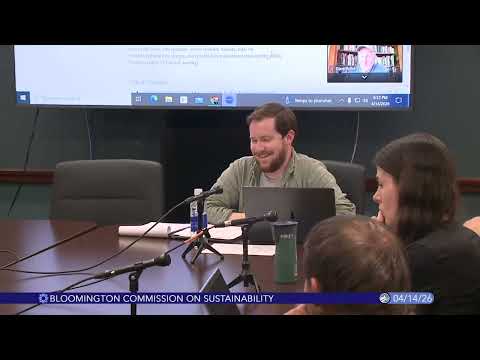
The Bloomington Commission on Sustainability and Resilience on April 14 paused final action on an advisory resolution that would discourage the city’s use of glyphosate, saying members needed more information before deciding.
After a structured question-and-answer period with two invited experts — Ellen Jart, president of MCIS (Monroe County cooperative invasive species group), and Mary Wells, natural resources manager for Bloomington Parks and Recreation — commissioners moved the resolution into formal consideration and then voted to postpone debate and any vote until the commission’s May meeting.
Why it mattered: the resolution, identified in the packet as Resolution 2026-04, responds to public concern about herbicide use in public spaces and would be an advisory instruction to city council, not an ordinance. Commissioners, staff and the invited experts debated trade-offs between ecological restoration goals, applicator safety, public-health evidence and operational costs.
What experts said: Ellen Jart, who has led invasive-species work across Indiana and coordinated volunteer field efforts locally, told the commission that "glyphosate is a really important tool in the toolbox and it would be devastating to lose it" for certain targeted invasive-plant treatments. Mary Wells said parks uses are largely in the natural-resources/operations division and described targeted methods: "over half of our use...is for cut stump applications on woody vegetation," followed by spot foliar treatments and limited broadcast site-prep applications. Wells said the department uses dye indicators, signage and an online pesticide portal and aims to minimize drift and off-target impacts.
Concerns raised: several commissioners pressed on scientific credibility and long-term ecological effects. One commissioner cited a high-profile critique of a safety review with industry authorship and asked how to trust studies influenced by manufacturers. Experts acknowledged the conflict on some studies but said glyphosate is among the most-studied herbicides globally and argued that some alternatives have larger drift or persistence risks. Commissioners also asked about public records, the city’s integrated pest management (IPM) review cycle and whether the city could provide up-to-date use volumes by department.
Procedural outcome and next steps: the commission first voted to consider the resolution for adoption and then, after deliberations and discussion about logistics and additional evidence, moved to postpone consideration to the May regular meeting. The postponement passed by roll call: 7 yays, 1 no, 2 abstentions. The chair said the resolution is advisory and would not automatically ban glyphosate if passed; commissioners requested an updated breakdown of glyphosate and other pesticide uses by city department and suggested inviting additional expert perspectives representing skeptical or alternative viewpoints before the May deliberation.
Votes at a glance: - Motion to consider Resolution 2026-04 for adoption: moved and seconded (entering deliberation). - Motion to postpone consideration of Resolution 2026-04 until the May regular meeting: Passed by roll call (7 yays, 1 no, 2 abstentions). Commissioners voting yes included Tara, Christopher, Council Member Rao, Quinton, Alex, Maria and Ross; Zach voted no; Justin and Matt abstained.
What comes next: commissioners asked staff to assemble updated usage data (by department and by product), to circulate the city’s integrated pest management plan in advance of the May meeting, and to consider inviting additional experts with differing perspectives. The commission will revisit Resolution 2026-04 at its May meeting, at which point members may propose amendments, consider additional evidence and vote.
Source and attribution: reporting is based solely on commission proceedings and on-record testimony from Ellen Jart and Mary Wells, who were the named guests in the transcript.