Get Full Government Meeting Transcripts, Videos, & Alerts Forever!
Get email alerts on the Land Use Rezoning topic
No spam. Unsubscribe anytime.
Upson County denies rezoning request for spring-water harvesting at Crest highway site
Summary
After an extended public hearing in which residents warned of long-term impacts to private wells and road-safety concerns from tanker traffic, the Upson County Commission voted to deny a rezoning request that would have allowed commercial extraction and bottling of spring water on a 22.86-acre parcel.
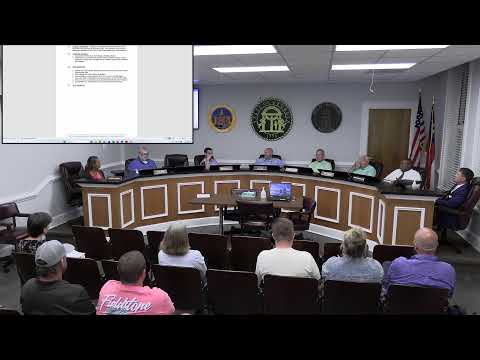
The Upson County Board of Commissioners denied a rezoning request on April 14 that would have allowed commercial water harvesting on a 22.86-acre parcel off Crest Highway. The vote followed a public hearing in which dozens of neighbors, local landowners and conservation stakeholders spoke against changing the property’s AR (agricultural/residential) zoning to M1 for water harvesting and bulk truck loading.
Opponents told commissioners the proposal threatened private wells, springs and agricultural uses in the Crest community. “What will this board do should they draw a gazillion gallons of water out there…what are you going to tell those 8,000 people on the water system when you don’t have water to sell?” said Rusty Blackston, a neighbor who identified concerns about aquifer depletion and the county’s long-term obligation to residents on county-supplied systems. Other speakers cited the county’s comprehensive plan and described the requested M1 zoning as spot zoning inconsistent with the plan’s land-use designations.
The applicant, identified in the hearing as Jeffrey Ellington, described a plan to drill one or two production wells near existing test wells, pump spring water to storage tanks inside a 40-by-60-foot building, and load tankers on site. Ellington told the board the loading cycle would take about 18–20 minutes, the on-site tanks would total about 30,000 gallons, and daily truck traffic at maximum performance would add roughly 32 truck movements (16 in, 16 out), plus employee vehicles. He proposed a radar-based traffic-monitoring and signal system—saying owner Jody Todd committed $18,000 for a one-way monitor—to protect line-of-sight issues on the curve near the site, and estimated 12–15 commercial driver jobs at about $100,000 per year.
Many speakers pressed the board on water impacts. The public raised questions about long-term drawdown on shallow domestic wells and springs, potential contamination pathways near an old landfill, and whether a county-only monitoring radius (applicant proposed monitoring wells within 1,500 feet) would meaningfully protect hundreds of nearby properties. Several commenters cited a history of other companies exceeding permitted withdrawals elsewhere and expressed skepticism about self-reporting and limited enforcement remedies at the state level.
Ellington responded that the operation’s realistic withdrawal estimate is about 70,000 gallons per day (roughly 25 million gallons per year) and that a maximum, state-threshold level would be 100,000 gallons per day (about 36 million gallons per year). He presented a recharge estimate for the spring’s contributing area (described in his materials as roughly 10.5 square miles) and said approximately 13.6% of precipitation (1.44 billion gallons per year) infiltrates to recharge the aquifer; on that basis he calculated the proposed withdrawal would represent roughly 1.7% of annual recharge at the realistic rate. Ellington proposed real-time monitoring of wells within 1,500 feet during testing, independent county-selected expert oversight of testing, and a conditional rezoning approach that would allow the M1 classification only if tests show no adverse effects.
Commission discussion focused on legal and policy questions: whether the request was consistent with the county’s 2023 comprehensive plan, the risk of creating spot zoning or precedent permitting similar withdrawals elsewhere, and whether zoning action should be conditioned in ways that could be enforceable. Several commissioners noted the state Environmental Protection Division’s 100,000-gallon/day threshold for permitting and said projects that monetize groundwater at that scale raise different regulatory and conservation issues than purely agricultural withdrawals.
Commissioner Biggs moved to deny the rezoning request; Commissioner Jones seconded. Commissioner Ellington, who had disclosed a family name match and recused from deliberation, recorded an abstention. The motion to deny carried by majority vote, and the rezoning request (REZ 2026-02) was denied.
What happens next: Commissioners and staff noted legal and procedural limits on how narrowly they can restrict a rezoning and signaled staff and planning commission review would be the proper avenue for any future code changes (for example, adding a special-use category or text amendment). The applicant said he would proceed with testing only if allowed to do so under the conditions he proposed and that pumping would stop if independent monitoring found adverse effects.
Authorities and details: The hearing referenced the county’s comprehensive plan (adopted/updated July 25, 2023), state oversight thresholds for groundwater withdrawal (100,000 gallons/day was cited in the discussion), and a local parcel identification number given in the application (tax parcel 014-039 BRAVO; REZ 2026-02). The applicant’s materials described two prior test wells near the spring, potential production well(s), the site driveway rebuild to DOT specifications, and a monitoring approach for nearby wells during testing. Many commenters requested a hydrological impact study and broader, independent long-term monitoring before any permit or rezoning allowing sustained extraction would be approved.
The commission closed the public hearing and moved on to other agenda items, including two separate beer-and-wine license transfers and referrals of zoning text changes to planning staff.