Get Full Government Meeting Transcripts, Videos, & Alerts Forever!
Get email alerts on the Short Term Rentals topic
No spam. Unsubscribe anytime.
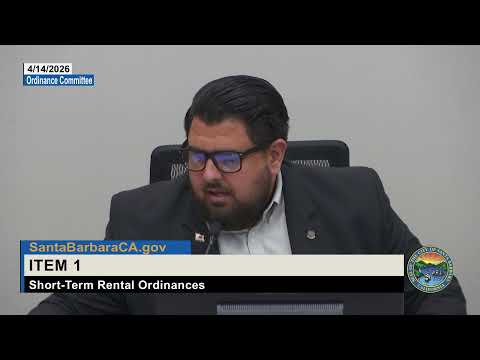
Santa Barbara ordinance committee advances short‑term rental ordinance for further review after hours of debate and nearly 40 public comments
Summary
City staff presented a draft short‑term rental ordinance that would create a permit and license system, define coastal license areas, set parking and enforcement rules and use SB 346 platform reporting; committee members extensively questioned staff and the committee voted to continue the item for further work.
City of Santa Barbara staff on April 14 presented a draft short‑term rental (STR) ordinance that would create a licensing program, set where whole‑home STRs and home shares would be allowed, and add enforcement tools aimed at reducing neighborhood nuisance and preserving housing stock. After lengthy technical questioning and almost 40 members of the public speaking for and against the proposal, the ordinance committee voted unanimously to continue the item for further consideration.
The staff presentation, led by principal planner Rosie Dyster, framed the ordinance as an implementation step for the city’s adopted housing element and a way to provide “a straightforward and reliable permit process” and “a legal framework by which [the city attorney’s office] can do enforcement moving forward,” Dyster said. The draft includes parallel amendments to inland zoning (Title 30) and coastal zoning (Title 28), a coastal license area map, and a home‑share option intended to preserve some lower‑cost overnight accommodations in the coastal zone.
The ordinance would define short‑term rentals as an entire dwelling rented for 30 consecutive days or less and home shares as a portion of a primary residence rented part time. Staff proposed prohibiting STRs in single‑family and two‑family zones while permitting STRs in commercial, mixed‑use and some residential/multi‑family zones. Home shares would be allowed in most residential zones that permit residential uses. The draft also lists ineligible unit types, including accessory dwelling units (ADUs) subject to recorded covenants and employee housing, and requires licenses to include ownership documentation, liability insurance and pre‑inspection.
Parking, enforcement and platform accountability were focal points. The draft requires two on‑site parking spaces for many units and three spaces for five‑bedroom homes; tandem parking would be allowed only with a public‑works waiver in most cases. Staff reported that the Planning Commission found the parking rules “too restrictive” and suggested honoring existing nonconforming parking or loosening backing‑out requirements. On enforcement, staff said performance standards for noise, occupancy and parking would be conditions of a license and that, under Senate Bill 346 (2025), platforms can be required to post license information and provide listing addresses to jurisdictions.
Finance data cited by staff showed transient occupancy tax (TOT) revenues attributed to STRs as roughly $2.8 million in fiscal 2024 and $4.4 million in 2025, with about $2.7 million collected through January 2026; staff also reported roughly 255 coastal‑zone units remitting TOT and a small number of inland units that had completed a formal change‑of‑use process. Members repeatedly pressed staff for clarity on counts, the enforcement workload, permit sequencing and potential loopholes (for example, whether long renovations could be used to circumvent a 24‑month lookback rule for prior long‑term occupancy).
Councilmember Jordan and others questioned many implementation details: how ADUs are treated, when nonconforming parking would trigger upgrades, whether licenses transfer with property sales or trusts, the appeal and revocation process, and whether the city should explore cap or lottery systems instead of a zoning‑based approach. Staff said alternatives such as citywide caps or lotteries had been used successfully in other coastal jurisdictions but would require more outreach and research before they could be recommended.
Public comment underscored the split in the community. Dozens of residents from the Mesa and other neighborhoods urged strict limits or an outright ban in coastal residential areas to protect neighborhood character, fire safety and housing availability; examples included pleas to prohibit STRs in high fire‑hazard areas and to prioritize long‑term housing. Operators, property managers and hospitality stakeholders warned that the draft would eliminate much of the STR supply, potentially costing the city millions in TOT revenue and local jobs. Several speakers representing Visit Santa Barbara, the South Coast Chamber and local management companies requested additional fiscal analysis, citing differing estimates of potential revenue loss.
Licensed operators and managers asked for clearer grandfathering rules and raised legal concerns about draft provisions such as nontransferable licenses, naming the city as an additional insured on private liability policies, and indemnification clauses. Kelly Ari, owner of Pacific Time Management, told the committee that transfer restrictions and insurance requirements could be legally and financially problematic for long‑standing operators.
Planning commission chair Lucille Boss also told the committee that the commission had forwarded the ordinance with numerous reservations and a request for additional analysis, particularly on waivers, enforcement funding and whether a zoning‑based approach is appropriate. Multiple speakers, including planners and regular participants in the zoning review process, urged the committee to allow staff and the Planning Commission more time to analyze alternatives and implementation consequences.
After the public testimony, Chair Gutierrez moved and Mayor Pro Tem Snedden seconded a motion to continue the item to the next ordinance committee meeting to allow time for additional work and scheduling adjustments. The committee voted unanimously to continue the item; a new date and time will be noticed.
What’s next: staff said the package would be refined and is slated for City Council introduction and adoption in May 2026, followed by a Local Coastal Plan amendment to the Coastal Commission this summer; Coastal Commission review is anticipated in late 2026 or early 2027. Committee members asked staff to return with clarified counts, a firmer enforcement and funding plan, legal feedback on license transferability and indemnities, and options analysis on caps or lottery systems for potential future consideration.