Get Full Government Meeting Transcripts, Videos, & Alerts Forever!
Get email alerts on the Annexation topic
No spam. Unsubscribe anytime.
Council asks staff to refine two annexation requests covering about 38 acres; applicants may be asked to pay consultant costs
Summary
City staff presented two annexation petitions for parcels on the east and west sides of Enumclaw and recommended modifying boundaries to create a roughly 38-acre consolidated area; council asked staff to consult the city attorney and return with options, including processing the petitions separately and requiring applicants to cover consultant costs.
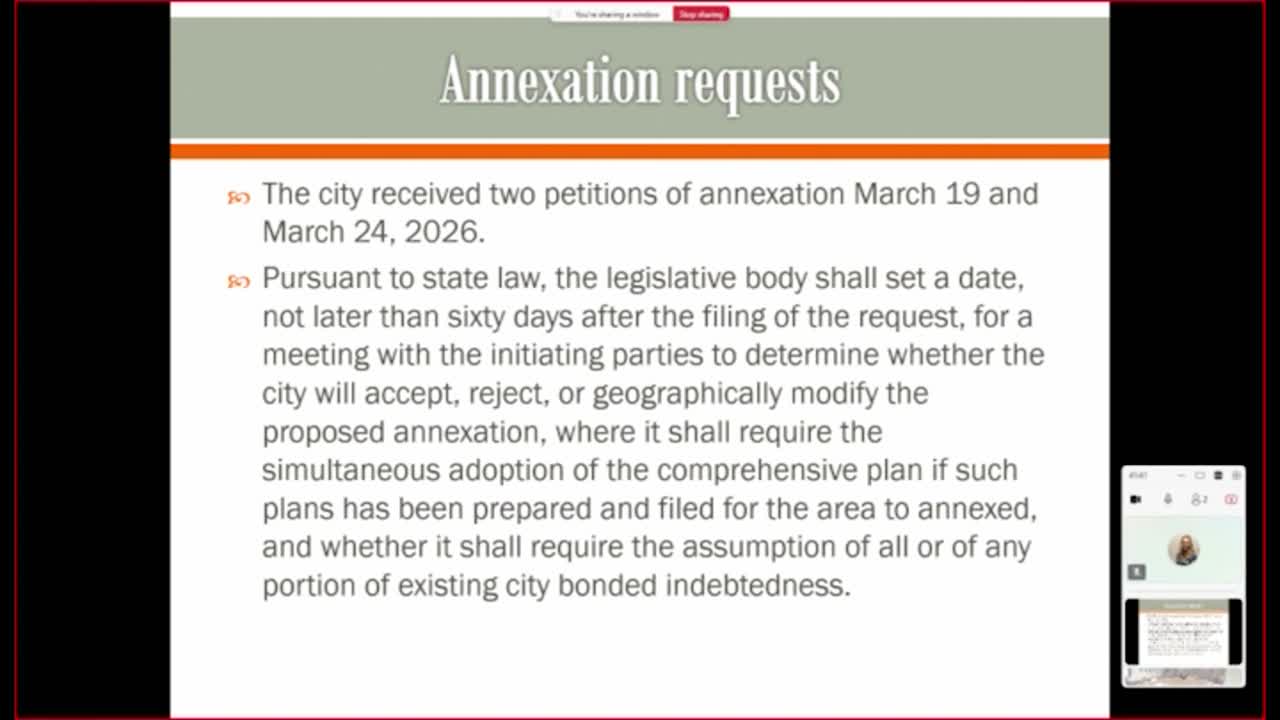
City staff told the Enumclaw City Council on April 27 that the city has received two annexation requests affecting five vacant residential parcels and that staff recommends expanding the proposed boundaries to create a more regular city limit and comply with the comprehensive plan.
Community Development Director Chris Massenet said the two requests were filed in March and involve parcels on both the east side (near the King County fair/expo) and the west side (near the Roosevelt Avenue roundabout). He said water and gravity sewer are available adjacent to both areas and that staff’s modified proposal would increase the total to roughly 38 acres with an estimated valuation of about $8.5 million.
"With the additional parcels, it would be roughly 38 acres in total with an evaluation of about 8 and a half million," Massenet said. He recommended the council consider modifying the requested areas so the city boundary is more regular and to prepare either one resolution covering both areas or two separate resolutions.
Council members asked procedural questions about the statutory 60% petition method for annexation, the role of the Boundary Review Board, and whether the applicants’ parcels alone would meet the 60% valuation threshold. Massenet said the Tarragon parcels do not by themselves reach the 60% and that the applicants would need additional owner signatures if those areas were processed separately.
Several council members also said the workload of running two annexations could be large and asked staff to consult the city attorney about whether the council could require applicants to pay for a consultant to do much of the annexation work. One council member urged processing the requests separately so that property owners are treated equitably.
Council members gave staff informal direction—head nods and requests—to return at the next meeting with draft resolutions and with advice from the city attorney about potential conditions, including requiring applicants to fund consultant work or otherwise reimburse the city for consultant costs.
Next steps: staff will consult the city attorney and return with revised resolutions (either one consolidated proposal or two separate measures) and recommendations on possible applicant-funded consultant conditions and other procedural options.