Get Full Government Meeting Transcripts, Videos, & Alerts Forever!
Get email alerts on the Public Health topic
No spam. Unsubscribe anytime.
Orange County opens new $15 million mosquito control facility with solar arrays and climate‑controlled insectary
Summary
Orange County officials on Monday marked the ribbon-cutting of a new mosquito control facility in Pine Hills, calling the "little over $15,000,000" project a boost to public‑health preparedness that adds laboratory space, a climate‑controlled insectary and rooftop solar arrays.
Orange County officials on Monday celebrated the ribbon-cutting for a new mosquito control building in the Pine Hills community, calling the facility an investment in public‑health preparedness and sustainability. County Administrator Byron Brooks said the project — "a little over $15,000,000" — will expand surveillance and response capacity as the county continues to manage mosquito‑borne illness advisories.
Brooks said the investment "positions Orange County to meet the demands of our growing population while strengthening our public health infrastructure for the future," and he listed recent local advisories for West Nile virus, Zika and dengue as part of the rationale for the project. He also noted that the building's roof includes 360 kilowatt solar arrays and that electrical infrastructure was designed to support a transition to alternative‑fuel vehicles.
Steve Harrison, division manager for mosquito control, described the facility's operational features and thanked the architects, construction team, capital projects staff and contributing artists. "This building is more than just a new building. It represents progress, innovation, and a long term commitment to the community that we serve," Harrison said, noting the addition of expanded laboratory and operational space, improved training and response capabilities, and a climate‑controlled insectary to strengthen mosquito surveillance and public‑health response efforts.
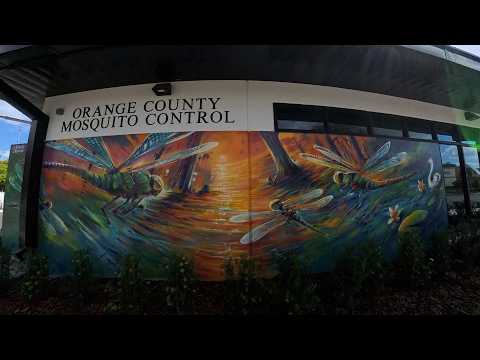
Harrison detailed environmentally conscious design elements, including solar power and a secure chemical storage area built "like a shallow swimming pool" with a specially coated surface designed to contain and filter accidental spills so that liquids can be safely contained and reused for their intended purpose. He also highlighted the involvement of local artists, including sculptures of barn swallows and a mural of dragonflies, as part of the facility's site design.
Commissioner Mike Scott (District 6) framed the project as both a safety investment and a community development opportunity, praising the capital projects team and the artists and saying the site will provide jobs in the surrounding districts.
County staff invited the mosquito control team and local leaders to the ribbon and photographs. The ceremony acknowledged partners named by Harrison — including KMF Architects, CIC Construction and members of the county capital projects division — and thanked neighborhood residents for welcoming the facility into Pine Hills. No formal votes or policy actions were taken at the event; it was a ceremonial opening and public acknowledgment of the completed project.