Get Full Government Meeting Transcripts, Videos, & Alerts Forever!
Get email alerts on the Managed Parking topic
No spam. Unsubscribe anytime.
Ogden council weighs phased rollout of managed downtown parking
Summary
City staff told council members a kiosk-based managed-parking program will start with a 30‑day trial after ordinance adoption, but council members pressed for clearer revenue projections, firm dates for later phases and more data about the reduced initial footprint.
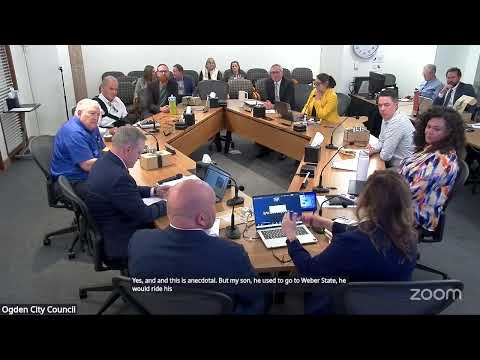
Ogden City Council members and city staff discussed a phased rollout of a downtown managed-parking program during a work session, with staff proposing kiosks and a 30-day trial to begin after the ordinance is approved.
City staff said the initial implementation will be smaller than the footprint used in earlier planning and emphasized community outreach, including door-to-door packets for downtown businesses, social media, a newsletter and information on the city website. "Once the ordinance is approved we would like to take 30 days and have that be our trial period," a presenter identified in the meeting as Lisa said, outlining an install-in-May target for the first kiosks.
Why it matters: Staff told the council that shrinking the program's initial geographic footprint — from roughly 10 blocks in earlier plans to three to five blocks, and in some places only one side of a block — materially reduced near-term revenue projections. Council members said that gap matters for bond and capital-improvement funding tied to parking revenue and pressed staff for clearer numbers and firm dates for subsequent phases.
Details and debate: Staff described how paid parking revenue could be reinvested in downtown maintenance and operations. The presenter said agreements with PRI, Foyer and the redevelopment agency (RDA) currently help pay common-area maintenance (janitorial, lighting and other services) for some parking towers; staff warned that RDA expiration could create funding gaps and said paid parking revenue would help sustain upkeep and electrical costs for charging stations. Staff also told the council that about 200 residents near the college hold electronic residential permits; paper permits were converted to an electronic permit in January and no permit fees have yet been charged.
A council member voiced frustration with the projections. "These are way off," the member said, asking staff to explain why earlier revenue estimates did not materialize. Staff replied that the implementation area is much smaller than the 2022 Kimley Horn plan the council had approved and that lower staffing and equipment needs also reduced both costs and revenue expectations.
On the intended effects of pricing, staff said paid parking is intended to increase turnover and improve availability close to the businesses that rely on short-term parking. "There's a certain distance that people will walk and there's a certain distance they won't walk for free," Lisa said, describing how drivers may tolerate walking farther to avoid paying, which can create closer-in openings. Council members also noted that managed parking can allow customers to stay longer by paying rather than moving vehicles repeatedly, a feature some businesses had requested.
Council members asked staff to run scenario models showing the revenue impact of modest expansions (for example, adding specific blocks such as Grant Avenue or blocks between 24th and 26th Street) and requested that administration return with data two to three months after initial implementation and, if possible, firm dates for phase two and phase three. One council member suggested a visible pilot plan — install a subset of kiosks and run them with a grace period so the public sees the future footprint as the rest of the system is installed.
No formal action or vote occurred at the session. Staff said they will prepare additional projections for the council and noted a leadership meeting was rescheduled to the next day at 3:30 p.m. The work session then concluded.