Get Full Government Meeting Transcripts, Videos, & Alerts Forever!
Get email alerts on the Conservatorship topic
No spam. Unsubscribe anytime.
Scranton Redevelopment Authority says court has granted conservatorship for pilot at 25 New York Street
Summary
The SRA’s director said a judge appointed the authority conservator for 25 New York Street; Cutillo described conservatorship as a legal path to inspect and rehabilitate neglected properties, recover costs through liens and sale, and — he hopes — to motivate some owners to act without full SRA intervention.
The Scranton Redevelopment Authority has begun using a state conservatorship process to address an especially neglected property, the authority’s new executive director told a city caucus.
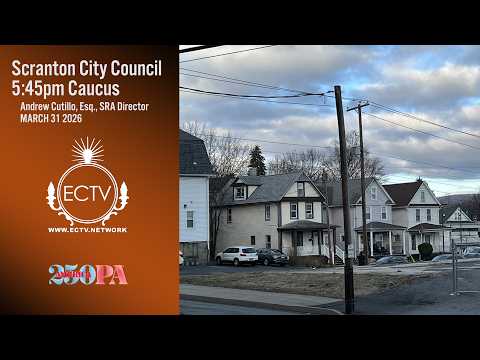
"We were appointed by the judge to be the conservator for that property," Andrew Cutillo said, describing 25 New York Street as largely unoccupied for years. Cutillo said the court recently granted conservatorship, which lets the SRA enter, inspect and, if necessary, rehabilitate the property with court oversight.
Cutillo contrasted conservatorship with eminent domain: rather than purchasing a property at fair market value before rehabbing it, conservatorship allows the authority to perform necessary work, tally its administrative and contractor costs, place a lien on the property, and — if the owner does not reimburse expenses — ask the court to sell the property and recoup SRA costs first. "All of that's encompassing in that lien you put on the property," he said.
He warned the process can be costly and time-consuming: attorneys’ fees, filing fees and other fixed costs create a "high fixed cost" to bringing conservatorship actions. That is why the SRA will use the pilot to assess project-level costs and timelines before taking on many more properties. Cutillo said the period from filing to a first court hearing in this pilot was about two to three months but stressed judges’ schedules and case specifics make the timetable uncertain.
Cutillo said the SRA’s goal is not to take people’s homes, but to encourage owners to act: "The mere threat of a conservatorship is enough to spook a property owner into getting their act together," he said, noting some owners will rehabilitate voluntarily once faced with potential court action.
Council members suggested cost-saving partnerships with local vocational and trade programs to provide project labor and training. Cutillo confirmed he has discussed similar models with local nonprofit partners and said the SRA would explore using programs that can both reduce costs and provide student training opportunities, while keeping an eye on cost recovery.
Next steps: Cutillo said the SRA will submit a final plan to the court for 25 New York Street and is awaiting the final inspection report to refine cost estimates and procurement plans. The authority will use the pilot to determine how quickly and frequently it can reasonably pursue additional conservatorship cases.