Get Full Government Meeting Transcripts, Videos, & Alerts Forever!
Get email alerts on the Pfas Investigation topic
No spam. Unsubscribe anytime.
NJDEP says private‑well cluster in Lambertville area under PFAS investigation; POETs to be provided to affected homes
Summary
NJDEP staff told a webinar audience that a cluster of private wells in the Bader Avenue/Allen Street area is being investigated for PFAS contamination. The department is sampling to map the contamination, will pursue source identification and responsible‑party cleanup if found, and is installing point‑of‑entry treatment systems to ensure safe drinking water in the near term.
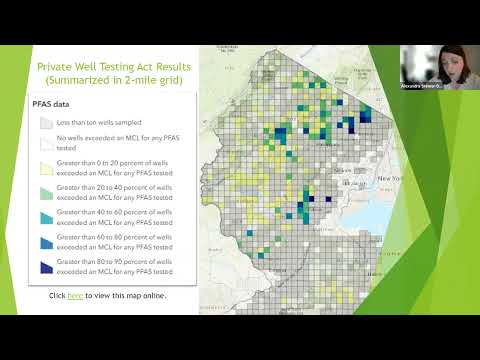
Alexander Skinner, a supervisor with the New Jersey Department of Environmental Protection’s Immediate Concern Unit, told a Lambertville/West Amwell webinar audience that the department is conducting a private‑well investigation after an attorney for West Amwell alerted the agency to multiple contaminated wells in the Bader Avenue and Allen Street area. Skinner said the department is developing a “currently known extent” of groundwater contamination and scheduled additional private‑well sampling for December 17, 2024 to determine how far the contamination extends.
Skinner defined the chemicals discussed as “per‑ and polyfluoroalkyl substances,” presented in the talk as “posos,” and said they are persistent, resist degradation, and are commonly found in consumer and industrial products. He told residents PFAS “can be found in surface water, groundwater, soil and air” and noted common sources include landfills, AFFF firefighting foams, manufacturing facilities, wastewater effluent and biosolids.
NJDEP staff described the department’s response as twofold: first, ensure affected residents have safe drinking water; second, complete an unknown‑source investigation to identify any responsible party. If a source is found, Skinner said the property owner or responsible party would be required to retain a licensed site remediation professional and remediate the site under state technical requirements; if the responsible party cannot or will not act, the state may use funds to complete remediation.
On near‑term protection, Skinner said the department’s priority for private‑well impacts is installation of point‑of‑entry treatment (POET) systems that filter PFAS at the home’s water entry point. He explained that, in some cases, connecting properties to a public water line may be considered as a long‑term remedy if that is the most protective and cost‑effective solution for the community.
Residents raised questions about potential local sources, including a former municipal landfill and a proposed development at the old high school site; Skinner said the unknown‑source investigation includes records searches and targeted soil and groundwater testing at sites determined to be potential sources. He emphasized that where a source of PFAS contamination is identified, cleanup is required by the responsible party under state rules.
The department committed to posting the webinar slides and resources on the city website and to notifying residents within the investigation radius about sampling. For community questions and updates, staff identified Greg Brazowski in NJDEP’s Office of Community Relations as a local contact.