Get Full Government Meeting Transcripts, Videos, & Alerts Forever!
Get email alerts on the Great Lakes Crisis topic
No spam. Unsubscribe anytime.
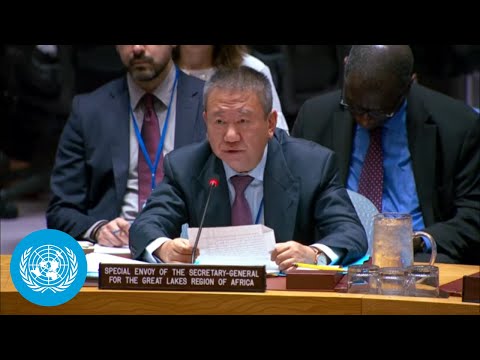
Huang Xia warns of worsening Great Lakes crisis, urges swift operationalization of ceasefire oversight
Summary
In a Security Council briefing, Mr. Huang Xia said diplomatic accords have not yet translated into action, described intensified warfare tactics and severe humanitarian harm, and urged the Council to back operational ceasefire oversight, humanitarian corridors and regional mediation.
Mr. Huang Xia told the Security Council that the humanitarian and security situation in the Great Lakes region has worsened since his previous briefing, and that a growing gap between political commitments and reality on the ground is the Council’s “main collective challenge.”
Huang said diplomatic initiatives — including the Washington and Doha processes — have opened opportunities, noting the signing of the Washington Accords on Dec. 4. He added that the temporary capture of Uvira by the M23 days later had “severe consequences for civilians and regional relations.”
The briefing detailed steps in Doha, where delegates established a ceasefire oversight and verification mechanism and adopted terms of reference for an enhanced joint verification mechanism (EJVM plus). Huang welcomed the resumption of negotiations co‑facilitated by Qatar and the United States and hosted with support from Switzerland, and urged “swift operationalization of the protocol on the oversight mechanism” and six pending Doha protocols.
Huang said Congolese authorities informed him they were preparing operations against the FDLR and running an awareness campaign to offer fighters the possibility to surrender voluntarily; he also reported observed withdrawal movements by some M23 elements. He warned the conflict has taken on a new dimension, citing “drone attacks, GPS jamming and spoofing, [and] bombings,” and noted the death of a UNICEF employee in Goma on March 11 as evidence of the conflict’s toll.
On humanitarian conditions, Huang said “several million people remain displaced and facing food insecurity,” and he flagged rising sexual violence, attacks on humanitarian workers and destruction of essential infrastructure. He also warned of a worrying rise in hate speech and identity‑based polarization that can be instrumentalized into cycles of reprisals.
Huang described his office’s increased engagement: travel to Lomé, Addis Ababa and Doha to support mediation; consultations with Uganda in its chairmanship role; and support for standardized operating procedures (SOPs) for disarmament, demobilization, repatriation and reintegration of foreign armed groups, which he said will be endorsed at a ministerial meeting scheduled for June. He highlighted coordination with UN entities (UNFPA, UNDP, UNICEF), the African Union, ICGLR, UNHCR and the European Union on youth, refugee and stabilization work.
Huang appealed to the Council to press the parties to implement commitments, saying the immediate priority is “the establishment of an effective, verifiable and fully respected ceasefire” whose credibility relies on operational oversight and the EJVM plus. He urged members to strengthen engagement to secure humanitarian corridors guaranteeing safe, swift and unimpeded access to populations in need.
He closed by calling on the DRC, Rwanda and AFC M23 and other concerned actors to resume frank dialogue to ease tensions and ensure timely implementation of commitments.
The Council member presiding at the meeting thanked Mr. Huang for his briefing and gave the floor to Ms. Sim Masami Bahous for the next update.