Get Full Government Meeting Transcripts, Videos, & Alerts Forever!
Get email alerts on the Ethics And Conflicts topic
No spam. Unsubscribe anytime.
Stockton Unified trustees receive CSBA ethics and conflict‑of‑interest training
Summary
Trustees at Stockton Unified attended a California School Boards Association training covering AB 2158 ethics requirements, gift limits and reporting, Brown Act meeting rules (including teleconferencing), Government Code 1090 conflicts and public‑records obligations; presenters urged recusal and consulting legal counsel when in doubt.
Stockton Unified School District trustees attended a board retreat hosted May 12 that the California School Boards Association delivered to satisfy statutory ethics training requirements, presenters said.
Kristen Lingren Bone, general counsel for the California School Boards Association, and Ethan Ran, CSBA deputy general counsel, led a multi‑hour session on ethics, conflicts of interest and open‑government laws. Bone told trustees the session fulfills AB 2158’s mandated ethics training (effective Jan. 1, 2023; required beginning Jan. 1, 2025) and reviewed the district’s bylaws that govern gifts and conflicts.
“It is important to think about what something will look like to the public — even the appearance of impropriety is problematic,” Bone said, urging trustees to consult legal counsel on close questions. She reviewed criminal and civil penalties attached to bribery and violations of the Political Reform Act and said gift reporting is broadly required: gifts of $50 or more must be reported on Form 700 and the per‑source limit was $590 for 2023–24 (adjusted periodically).
Ran explained restrictions on loans and contracts, including Government Code section 1090, which broadly bars contracts involving public officials who have a financial interest. “If a prohibited conflict exists, the contract is void,” Ran said, describing exceptions such as remote‑interest rules, non‑interest categories and the narrow rule of necessity that can allow action when no other entity can perform an essential public function.
The presenters also reviewed Brown Act obligations for public meetings, including notice requirements, the risk that serial or “hub‑and‑spoke” communications can create unlawful meetings if a quorum’s positions are conveyed outside public session, and teleconferencing rules under AB 2449. Ran summarized just‑cause remote participation (child care, contagious illness, disability, travel), a two‑meeting‑per‑year limit for just cause and technical requirements for remote locations and public access.
On transparency, presenters said Form 700 filings are public records, filed under penalty of perjury; designated filers must submit initial statements within 30 days of taking office and annual statements (commonly by April 1). They also reviewed public‑records obligations under the California Public Records Act, including the 10‑calendar‑day written response requirement to acknowledge receipt of a request (with a possible 14‑day extension for complex requests).
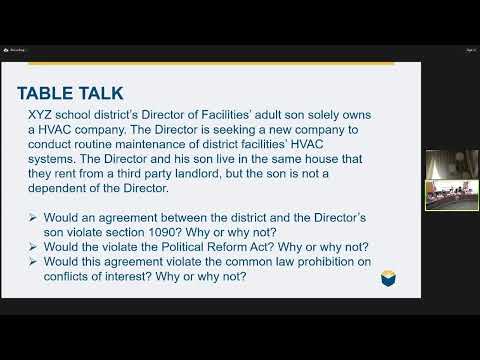
Throughout the session, CSBA used hypotheticals to show how the rules apply in practice — for example, how two $300 golf certificates from a vendor could be handled to avoid exceeding the gift limit, or when a board member’s family relationship might require recusal but not bar a contract under certain rules. Presenters repeatedly advised trustees to disclose potential conflicts, fully recuse when required and seek legal advice for fact‑specific determinations.
The retreat included a roll call (President Kena Stevens; Vice President Sophia Colone; Clerk Donald Dair; trustees Angelan Flores, Cecilia Mendes, Alisia Rico and Raymond Zulueta) and no public comments were recorded at the meeting’s start. The board recessed during the training and reconvened to continue the presentation; the session concluded and the meeting adjourned at 7:02 p.m.
The training materials referenced board bylaws (including local bylaws numbered in presentation slides), the Political Reform Act and Form 700 procedures, Penal Code provisions on bribery, Government Code section 1090, AB 2158 and AB 2449, the Brown Act and the California Public Records Act. CSBA presenters made clear that the training is informational and not a substitute for legal advice; trustees were encouraged to consult district counsel for situational guidance.