Get Full Government Meeting Transcripts, Videos, & Alerts Forever!
Get email alerts on the Flood Protection topic
No spam. Unsubscribe anytime.
Engineered levee and pump station credited with preventing flooding in Huntington, presenters say
Summary
At a public information session, engineers described how a completed levee and a backup-powered pump station on Cameron Run are designed to protect the Huntington neighborhood from storm and high-tide flooding, and said the system kept water below bank during a recent event.
Engineers at a public information session described how a newly completed levee and an accompanying pump station on Cameron Run are intended to protect the Huntington neighborhood from storm and tidal flooding.
Daniel Hap, who identified himself as handling stormwater planning, said the levee "disconnect[s] the Cameron run from community," keeping high-tide and storm water from lingering in neighborhood streets. He added that before the project the area had been mapped by FEMA as a high-risk flood zone; after construction the community has been treated as a "levee protected community," a change Hap said required submitting hydrology and hydraulic analyses and other documentation to FEMA for accreditation.
Why it matters: FEMA accreditation can alter flood-insurance classifications for properties in the area, and the system’s reliability determines whether homeowners face recurring inundation during major storms.
Engineered features and operation
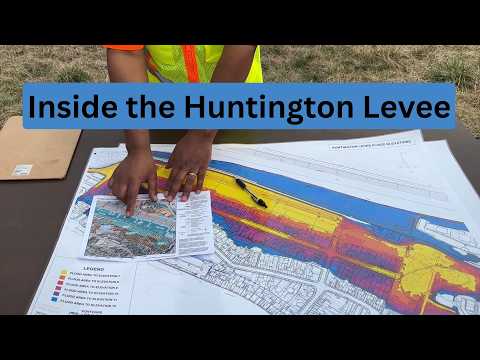
Hap said about 1,775 acres drain to the project outfall and that the levee runs roughly 2,900 feet from high ground to the Riverside Apartments. He described a 4-foot concrete eyewall cast over sheet piles driven about 13–15 feet as part of the structure. "These are the elevations where the 100 year storm going to be," Hap said when discussing design elevations and mapping.
Aaron George, who introduced himself as a dam safety engineer at MSMD, described the project’s physical barrier: "We've got over a half mile of levee embankment, sheet pile and concrete eyewall," he said, and added that because the levee confines Cameron Run the drainage system must rely on the pump station. George said the station’s low-flow pumps operate first and, as levels rise, the system automatically brings higher-capacity pumps online; the station then discharges through a engineered outfall that conveys pumped water safely back into Cameron Run.
George said the system was tested in the field soon after commissioning: "About a month after this was fully put in service we got an event that in Cameron Run would have flooded Huntington," he said, adding that during that event the ponding area rose to "about elevation five" and did not breach the banks (overtopping would occur around elevations six to seven).
Brad, the pump station business operations manager, described on-site equipment and redundancy: the low-flow pumps operate in stages, a fourth pump serves as a backup, bar screens remove debris before it reaches high-flow pumps, and a 1.5-megawatt generator provides on-site power if the utility supply is lost, with automatic sensing and transfer to ensure station operation. "In the event that we lose power, there's sensing equipment in here. They'll send a signal to the generator. The generator will start," he said.
Technical and community context
Presenters noted the project followed a 2009 U.S. Army Corps of Engineers study that evaluated multiple alternatives — from property buyouts and parkland to constructing a levee — and that the county selected the levee option. Hap said staff held regular meetings with the community during planning and construction to update residents on status and operation.
What was not decided
This session was informational: no motions or formal agency decisions were recorded in the transcript. Presenters described the design and operational performance but did not announce policy changes, funding decisions, or new regulatory actions during the remarks captured here.
Sources and attributions
Quoted speakers and attributions are drawn from the session transcript: Daniel Hap (stormwater planning), Aaron George (dam safety engineer, MSMD), and Brad (business operations manager).