Get Full Government Meeting Transcripts, Videos, & Alerts Forever!
Get email alerts on the Municipal Budget topic
No spam. Unsubscribe anytime.
Hope Mills board weighs tax increase after $2.07M sales-tax hit; prioritizes public safety and select capital spending
Summary
At a budget workshop, Hope Mills Town officials reviewed a projected $2.07 million annual sales-tax shortfall tied to a county distribution change, discussed raising the property tax rate above the 31-cent revenue-neutral level to fund public-safety needs and agreed to a follow-up meeting to refine options.
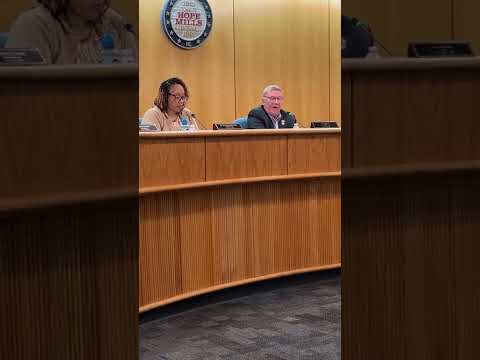
Hope Mills — Officials at a Town Board workshop reviewed a proposed budget that would raise the town’s property tax rate above its calculated revenue-neutral level to cover a recurring sales-tax revenue shortfall and to preserve public-safety spending.
Finance staff explained the revenue-neutral rate calculation — based on recent assessed values and an eight-year average growth rate — yields a 31-cent baseline. Board members were told a county change from a per-capita to an ad valorem sales-tax distribution will reduce the town’s annual receipts by roughly $2.07 million, a gap that translates to about a 10-cent increase in property tax. Staff added roughly four more cents to that baseline to fund ongoing public-safety costs, producing the proposed 45-cent rate in the packet presented to the board.
Why it matters: Board members repeatedly framed the issue as a trade-off between using one-time revenues and reserves or raising a recurring tax burden. Staff identified three one-time sources in the current plan — cell-tower proceeds (about $481,813), fund balance (about $418,187) and ARPA funds (about $661,375) — and warned that ARPA and fund-balance sources are not sustainable for covering ongoing expenses.
Budget arithmetic and shortfall Finance staff summarized the numbers and the mechanics: “That’s how we arrive at the 31 cents,” the presenter said when walking through the revenue-neutral calculation, and added that the town’s sales-tax shortfall and ongoing public-safety additions explain the recommended 45-cent rate in the proposed budget. Commissioners asked for clarity on the county’s ad valorem method; staff answered that the town still receives sales tax but the new allocation method reduces the town’s share versus the prior per-capita formula.
Public safety and capital priorities Board members treated several public-safety items as high priorities that are difficult to cut, including lease and debt payments for police vehicles, portable radios and body-camera packages. The board maintained funding for a standalone animal-control position (about $88,125) and kept a $100,000 line for fire-substation property/design after commissioners emphasized long-term response-time needs around growing neighborhoods and schools.
Other items retained after debate included a $49,250 upgrade to the council chamber’s audio-visual system for improved livestreaming access, a $12,000 one-year cost for planning/code-enforcement permit software (to be evaluated annually), and $6,700 to rekey internal town-hall office doors for key-control and security. Commissioners also approved adding HR laptops and keeping a proposed HR information system for later consideration; staff said the HR system includes implementation costs this year and recurring yearly fees thereafter.
One-time funding limits and next steps When the board absorbed the cell-tower buyer’s withdrawal — announced by staff late last week — it created an immediate shortfall in the one-time revenue assumed in the current budget. Staff and several commissioners warned against overusing fund balance year after year and noted ARPA monies will not be available to cover recurring costs next year.
As a result, staff ran scenario math showing that preserving the added items and replacing the lost cell-tower revenue would likely push a property-tax proposal closer to about 48 cents (an illustrative scenario discussed by the board) unless additional recurring revenue is found or some added items are cut. The manager offered to present alternative scenarios and the board scheduled a special budget workshop before the next regular meeting so staff can model the commissioners’ requested changes.
What was not decided There were no formal votes on an ordinance or final tax rate at the workshop. Several items were retained by board consensus for additional review, and staff was asked to return with updated numbers that attempt to hold the overall tax-rate impact near the board’s target while funding priority public-safety and operational needs.
Next procedural step The board set a follow-up special meeting (workshop) before its next regular meeting so staff can present revised budget scenarios, including an option that models the additions within a roughly 48-cent rate. The board will consider final adoption and any rate ordinance at a future meeting after seeing those revised numbers.