Get Full Government Meeting Transcripts, Videos, & Alerts Forever!
Get email alerts on the Utilities Infrastructure topic
No spam. Unsubscribe anytime.
Utilities committee approves contracts for heavy equipment, sewers, plumbing and substation maintenance
Summary
The Cleveland City Council Utilities Committee approved a set of Department of Public Utilities ordinances authorizing requirement contracts for heavy-equipment parts, sewer replacements, plumbing/backflow testing, distribution materials and multi-year substation maintenance. Council pressed officials for timelines, funding sources and assurances after recent multi-day power outages.
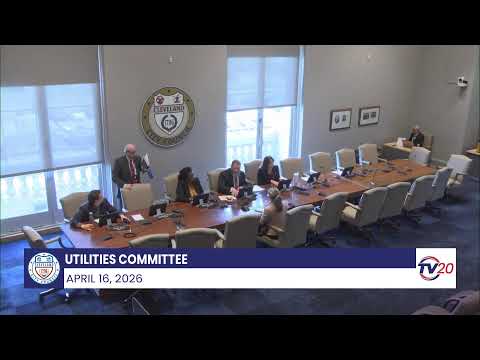
The Cleveland City Council Utilities Committee on April 16 approved multiple Department of Public Utilities ordinances to maintain city infrastructure, while members sought follow-up detail after recent service outages.
The committee voted to approve Ordinance 363-2026 to permit requirement contracts with Murphy Tractor and Equipment Company (a John Deere vendor) for proprietary replacement parts and repairs across divisions; the director said the two-year estimated spend is about $325,000. The committee approved Ordinance 407-2026, a roughly $5.4 million package of sewer replacement projects (Archwood Avenue, W. 39th Street, Bradgate Avenue, Clybourne Avenue, E. 58th Street and Luther Avenue) drawn from the Division of Water Pollution Control’s capital improvement plan; officials said project selection is based on pipe age, televised inspections and reported flooding and that funding will come from a mix of capital budget and, where available, loans or grants including the State Revolving Loan Fund and Community Cost Share programs.
Ordinance 408-2026 authorized two-year requirement contracts for plumbing services and required backflow-device testing and reporting for Department facilities; the director said existing delivery orders will bridge service until the new contract begins. Ordinance 409-2026 approved a requirements contract for PVC/FRE duct line materials used by Cleveland Public Power’s underground distribution, budgeted roughly $500,000 per year (historical usage has been lower).
The committee also approved Ordinance 410-2026, authorizing one or more requirement contracts for labor and materials to test, maintain and repair substation equipment — including transformers, switchgear, batteries, fiber optics, vegetation and roof/fence work — for Cleveland Public Power. The director said the division budgets roughly $3 million per year for these services and that the contract is intended to augment staff to address urgent needs across 33 substations.
Council members used the substation discussion to press for more information and assurances after a series of recent outages. Councilman Anthony Polensek described multi-day power failures over Holy Week, saying constituents and at least one business, Quasar Energy, “had to bring in fire up generators which according to them was costing them $3,000 a day” and that many residents lost food and could not reach CPP. He told the table: “I sat in my son’s car in my daughter’s driveway ... with my clipboard making phone calls and taking phone calls on Easter Sunday.”
The director apologized and said redundancies in the system were exhausted by repeated storms, limiting restoration speed: “Those redundancies were exhausted which resulted in our customers having an awful weekend.” She acknowledged call-center limitations for a large event and said the department deployed all available internal resources and contracted vendors (including JF Electric) where permitted. On whether crews refused to report to work, the director said employees may use accrued benefit time and that alleged refusals had not been formally reported to her office.
Committee members asked for follow-up materials including a timeline for sewer projects, spend-to-date on prior substation awards, and more precise information about which substations will receive work under the new contract. For sewer projects, the commissioner said the team televises mains, performs dye testing and responds to resident flooding reports to prioritize work. The ordinances passed and were recorded as approved by the committee.
Next steps: council requested staff to return with timelines, spend data and coordination plans; the committee set additional meetings on April 30 and May 14.