Get Full Government Meeting Transcripts, Videos, & Alerts Forever!
Get email alerts on the Finance topic
No spam. Unsubscribe anytime.
Limestone County Fiscal Court adopts standing orders to allow ACH and electronic transfers
Summary
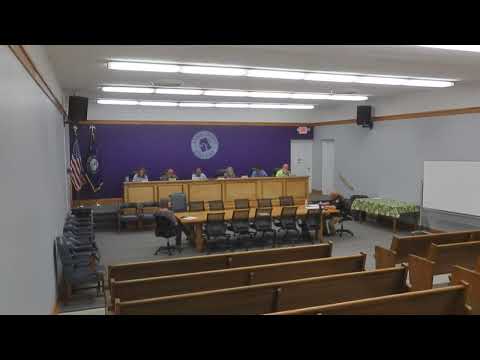
At a special session April 2, 2026, the Limestone County Fiscal Court approved amended standing orders that add a listed set of businesses and entities authorized to be paid by ACH or electronic funds transfer, citing a change in state law (KRS 68.275).
The Limestone County Fiscal Court on April 2, 2026, voted to adopt an amended fiscal-year standing order authorizing certain businesses and entities to be paid by automated clearinghouse (ACH) or electronic funds transfer (EFT), citing a change in state law.
The court’s speaker introduced the amended FY2026 standing order and referenced Kentucky Revised Statutes (KRS) 68.275, subsection three, as the statutory basis for the procedural change. Magistrate Sadler moved to accept the amended standing order and Magistrate Sutton seconded; the court voted in favor and the motion carried.
The court then considered the FY2026–2027 annual standing orders. The body approved two related documents — the regular standing order and a parallel standing order specifying ACH/EFT payees — in a single motion. Magistrate Cummings moved to accept both standing orders, Magistrate Sutton seconded, and the motion carried.
Officials did not provide a detailed list of the businesses or entities that will be added to the ACH/EFT authorization in the public remarks. The motion passed by voice vote; no roll-call tally was recorded in the public transcript.
The action is procedural: it changes county payment mechanics to allow electronic transfers for specified vendors in line with a cited change to KRS 68.275. The court did not attach additional budgetary or programmatic conditions to the standing orders during the session.
What happens next: the approved standing orders will remain in effect for FY2026–2027 unless the court amends them in a future meeting.