Get Full Government Meeting Transcripts, Videos, & Alerts Forever!
Get email alerts on the School Budget topic
No spam. Unsubscribe anytime.
Piscataway board adopts 2025–26 budget after heated public hearing over tax increase
Summary
After extensive public comment urging caution over a proposed tax-levy increase, the Piscataway Township Board of Education unanimously adopted the 2025–26 budget, citing a drop in state aid, rising health-care costs and a structural gap between the state's local-share calculation and the district's tax base.
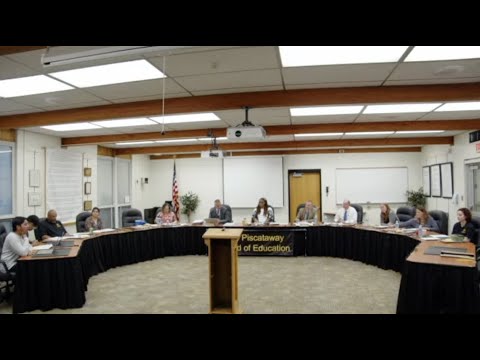
The Piscataway Township Board of Education on April 17 unanimously adopted its 2025–26 school district budget after a public hearing that drew residents sharply divided over a proposed tax-levy increase.
Supporters and opponents filled the public-comment period. Ed Smith testified he strongly opposed a roughly 5.5% tax increase and urged the board to delay new hires — including bilingual and special-education staff, a full-time nurse, a media center clerk and an IT specialist — or submit the question to voters. Other residents raised concerns about declining enrollment projections, the special-revenue fund and the local impact of municipal reassessments. Several commenters defended the budget as an investment in staff and student services.
Board members and administrators said the increase responds to specific fiscal pressures. The board presented a budget that managers said reflects an $800,000 reduction in state aid and identified a roughly $39.5 million gap between what the state’s funding formula calls the district’s local fair share and the district’s available local revenue base. The administration also described rising health-care costs and state-mandated programs as drivers that limit local flexibility; the board said it intends to use a combination of a one-time allotment of $4.2 million in surplus funds and previously banked levy authority to balance services and tax impacts.
"We take our role as public servants incredibly seriously," the board president said in opening remarks, describing outreach efforts and materials shared online and urging transparency. Interim Superintendent Dr. Roberto, who introduced himself at the meeting, described visiting nearly every district school and praised staff and programs as reasons to maintain proposed investments.
Teachers’ union leadership and other speakers urged municipal–school coordination on revenue streams. Joe Toma, president of the Piscataway Township Education Association, noted that payment-in-lieu-of-tax (pilot) agreements often do not send direct revenue to school districts and encouraged municipal negotiation and legislative remedies; he cited Senate Bill S59 as an example of proposed change. Some residents asked the township and state representatives to seek relief for large tax-exempt ratables in the municipal tax base.
After public comment and discussion, Dr. Connors—who outlined the state-calculation issues and noted the district’s rising health-care expenses—moved the budget for final adoption. The roll-call vote recorded unanimous "yes" votes from board members present and the motion carried.
The board also approved related personnel and labor-relations items and several fiscal and curriculum motions by roll call later in the meeting. The board noted capital and maintenance reserves (cited in meeting comments as approximately $29 million and $6.5 million respectively) provide flexibility for one-time projects without issuing debt.
Next steps: the adopted budget becomes the district’s official spending plan for 2025–26. Board leaders and speakers urged residents to direct questions to the administration and to contact municipal and state officials about broader funding and reassessment policies.
(Reporting note: figures and quotations reflect statements made at the April 17 board meeting and are reported as presented by speakers.)