Get Full Government Meeting Transcripts, Videos, & Alerts Forever!
Get email alerts on the Farmland Preservation topic
No spam. Unsubscribe anytime.
Corrales bond program will fund conservation easements to keep farmland in production
Summary
At a public briefing, Corrales’ Farmland Preservation Commission and the New Mexico Land Conservancy explained how a $2 million general-obligation bond will be used to purchase conservation easements, how easements work, and steps for landowners to apply; presenters also addressed concerns about county tax treatment of conserved land.
Corrales’ Farmland Preservation Commission held a public briefing explaining how the village’s general-obligation bond will be used to purchase conservation easements to preserve working farmland and wildlife habitat.
Co-chair Sam Thompson said the program responds to mounting pressure on local farms. “Agriculture is extremely important in the village of Corrales,” Thompson said, citing multi‑generational farms and past voter support for farmland bonds.
Jonathan Hayden, director of the New Mexico Land Conservancy, and other NMLC staff described the basic mechanics and scale of conservation easements. “We’ve conserved land across the state with 130 conservation easements,” Hayden said, and noted easements can be effective for parcels ranging from a couple of acres to very large holdings. Michael Cisco, the village’s contracted implementor, told attendees the village passed a $2 million bond to purchase conservation easements and described the application and approval steps: interested landowners meet with implementers, the Farmland Commission scores applications against criteria (viewshed, water availability, rural character, size, current use, biodiversity and location), and the Village Council makes final funding decisions.
The presenters said easements are voluntary, perpetual legal interests that landowners convey to a qualified holder such as a land trust. Claire Catlett of NMLC explained that owners retain title and may sell or mortgage property subject to an easement, but the easement restricts development rights and—importantly—can preserve water rights tied to agricultural use. “Easements are forever,” Catlett said, adding that land trusts perform annual monitoring and maintain insurance and legal-defense plans for enforcement.
Speakers summarized financial tools landowners can use. Under federal rules an easement donation typically qualifies as a charitable contribution (Catlett said the charitable valuation is commonly 40–60 percent of land value; certain qualifying farmers can claim up to 100 percent under IRS rules subject to limits and carryforward rules). New Mexico’s Land Conservation Incentives Act also offers a state tax credit or deduction (Catlett described a state credit generally valued at 50 percent of an easement’s appraised value, with a per-taxpayer cap she said is $250,000 and a doubled cap for married filers). Presenters also described NRCS bargain‑sale support, the Land of Enchantment Legacy Fund, and the option of donated easements.
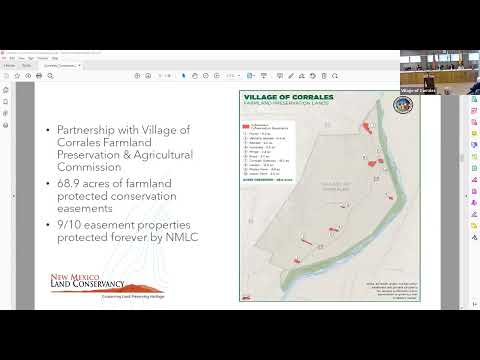
Presenters highlighted local examples: Chantel Bustillo described Treesa (an 18‑acre easement held with NRCS) and Lopez Farm (a multi‑generational property adjacent to the Rio Grande bosque that donates produce to food banks and is part of a new bird‑viewing trail). Bustillo encouraged residents to use the project’s story map and the village’s RSVP for an upcoming bird walk.
During Q&A, residents raised practical concerns. A homeowner identified as Anderson asked whether an easement can be undone if a homeowner repays bond funds; Michael Cisco replied no, except in narrow circumstances such as eminent domain. “No it can’t be undone through paying back the funds,” Cisco said. The discussion also covered lending: easements usually reduce market value used by commercial lenders, and some lenders (for example Farm Credit) are more easement‑savvy than commercial underwriters.
A Zoom participant, Alana McGran, said Sandoval County had required grazing or sales receipts to retain agricultural tax status in some cases and questioned whether local/state easements were being recognized by the county assessor. Jonathan Hayden and other speakers said that the county’s approach appears limited to one assessor’s office and urged pursuing either a legislative fix or an attorney‑general opinion to clarify tax treatment of state/local conservation easements.
Chief Anthony Martinez of the CR Fire Department raised public‑safety opportunities, asking whether easement properties could be used to support fire suppression (for example by siting cisterns or securing access). Presenters said easement terms are negotiated and can incorporate public‑safety provisions so long as the conservation values are preserved.
Michael Cisco summarized the timeline and approvals: interested landowners can obtain an application from the village website or at village offices, the Farmland Commission conducts site visits and scores properties, and the Council votes first to allocate funds and later to approve closings. Cisco said the final number of funded projects depends on demand and land prices; past Corrales bond cycles have ranged in the $2–2.5 million range.
Sam Thompson closed by reminding attendees that slides and application materials are posted on the village website and that hard copies of the application are available at village offices. He invited landowners with questions to attend the commission’s regular meeting schedule and to consult village resources for the exact application deadline and submission process.
Next step: interested landowners should review the materials on the Village of Corrales agriculture page and contact the village administrative office or the Farmland Preservation Commission for application forms and site‑visit scheduling.