Get Full Government Meeting Transcripts, Videos, & Alerts Forever!
Get email alerts on the Municipal Debt topic
No spam. Unsubscribe anytime.
Franklin reports $104 million G.O. bond issue; FY27 debt service to peak near $25.9 million
Summary
City staff told the Budget & Finance Committee the city closed $104 million in general obligation bonds in March, bringing outstanding G.O. debt to about $222 million and projecting FY27 debt service near $25.9 million (with approximately $21 million covered by property-tax revenues); water and sewer debt remains separate at about $122 million.
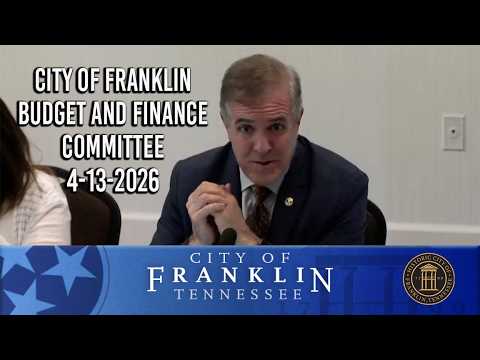
City finance staff presented a multi-part debt-service briefing on April 13, explaining recent bond activity, the interaction between general-obligation and utility revenue debt, and the schedule of upcoming debt-service obligations for fiscal 2027.
Michael Walters and finance staff said the city closed a $104 million general-obligation bond issue in March and repaid about $13 million of principal during the year; the net result leaves roughly $222 million of outstanding G.O. debt. Staff said water and sewer utility debt totals about $122 million and is tracked separately as revenue-backed debt.
Walters described the city's approach to debt management and credit reviews by Moody's and Standard & Poor's, noting staff and city leadership (including the mayor and city administrator) participated in rating- agency reviews. Speakers said that while water-and-sewer debt is paid from utility revenues, rating analysts consider the broader financial picture, including management practices and the health of enterprise funds.
Staff also outlined the debt-service schedule for FY27: total debt service will be near $25.9 million, an increase that partially results from recent bond issuances; nearly $21 million of that amount is projected to come from the current year's property-tax levy. Staff said specific debt-service allocations also tap the Road Impact Fund, hotel-motel revenues and other dedicated funds for certain projects and noted the peak in Road Impact Fund debt-service payments that taper off after fiscal 2032.
Committee members asked about rating-agency terminology, outlook categories, and the separate treatment of water/sewer debt. Staff said agencies have broadened their analysis to consider management quality and policy context and confirmed that utility revenue bonds are structurally separated from general-obligation debt even when analysts review the city's overall credit profile.
The committee discussed implications for multi-year planning; staff reiterated the FY27 recommended budget transmittal schedule and said debt metrics and coverage ratios will continue to inform rate and budget decisions.