Get Full Government Meeting Transcripts, Videos, & Alerts Forever!
Get email alerts on the Housing Affordability topic
No spam. Unsubscribe anytime.
Erie residents press council on affordability, tenant conditions and Bayfront incentives
Summary
Dozens of residents told Erie City Council on April 15 that Bayfront projects and hotel-led development are failing low-income neighborhoods; commenters demanded stronger code enforcement, tenant protections, and community benefit agreements while urging the city to pursue public‑developer models and worker protections.
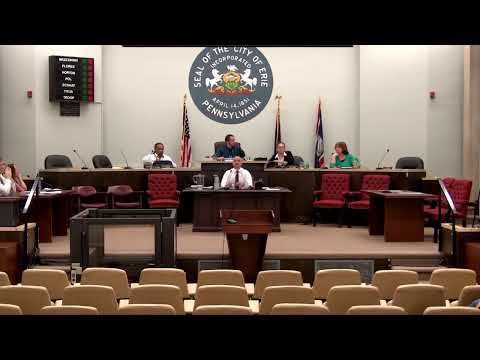
Dozens of Erie residents used the council’s public comment period on April 15 to press elected officials for immediate action on housing affordability, code enforcement and what speakers described as lopsided Bayfront development incentives.
Emerson Bannon, speaking for Erie County United and a local research team, urged the creation of a public developer to build permanently affordable housing and mixed‑use space under public control rather than depend on profit‑seeking hotel or market developers. “A public developer is a proven mechanism” that can build for residents, Bannon said, citing examples of other localities that have used public models to preserve affordability.
Nut graf: The night’s testimony — which stretched across more than three hours and included accounts from renters, disability‑benefit recipients and service providers — centered on two linked concerns: that new Bayfront and downtown projects will primarily serve tourists and higher‑income newcomers, and that long‑standing structural gaps (inspections, landlord accountability and service coordination) leave current residents vulnerable to unsafe housing and displacement.
Workers and tenants highlighted concrete problems. Nathan George, who said he works overnight at a county FedEx facility, described cut hours and pay that leave many households unable to afford market rents; he urged the council to consider local measures to support worker organizing and economic security. “Unmarried adults surviving on our warehouse wage fall short of a living wage,” George said, noting HUD rental estimates and United Way reporting cited earlier in his remarks.
Multiple residents described severe property conditions and landlord inaction. Sharnell Shepherd said mice, broken plumbing and boarded windows forced her move; Jim Deutschlander recounted persistent rodent infestations and asked for clearer accounting of maintenance dollars landlords claim to spend. “There should be some way to stop these landlords from renting people places in the shape like this,” Shepherd said.
Speakers also urged improvements to homelessness services and the coordinated entry system. A speaker identifying as Alice described cases where Erie County Care Management (ECCM) could not reliably identify which shelter beds were actually available and placed people into distant shelters without transportation, and asked the council to review ECCM capacity, support coordinator workloads, training and communication with providers.
Several commenters pressed for enforceable community benefit agreements (CBAs) tied to Bayfront incentives. Sydney Zimmerman criticized tax breaks and state grants directed at Bayfront developers and asked why the Erie Events Authority board had not been fully present to hear public concerns. “If they’re going to get money from the state or the city, then why isn’t it accessible to people who live here and work here?” Zimmerman asked.
The meeting also included a forceful allegation of police misconduct: Donald Way, who said he is autistic and on disability, alleged that a sheriff’s officer named Mr. Lawrence sexually assaulted him and described an investigation that reportedly cleared the officer. Way said people with disabilities are often criminalized and called for better protections and accountability.
Council response and next steps: Council members and the mayor acknowledged the volume of testimony and repeatedly referenced recent and upcoming administrative steps — including a study session on code enforcement and a planned strengthening of the inspection and licensing program. Multiple council members asked staff to gather written materials and consider a follow‑up public session or special meeting to allow more residents to participate. Mayor Daria Devlin noted outreach and logistics plans for future hearings and said the city is assembling nominations for a Strengthening Police and Community Partnership council, expected to begin meetings in May.
Why it matters: Testimony combined individual accounts of unsafe housing with policy proposals — from public development and worker protections to better inspection regimes and CBAs — that, if acted on, would change how Erie steers public investment and holds landlords and grant recipients accountable. Residents and organizers said they will continue pressuring the council and take parts of the campaign to Harrisburg if local steps fall short.
The council closed the public comment period and moved on to ordinance business; several participants were told staff would follow up and that a special evening meeting is being considered to capture broader public input.