Get Full Government Meeting Transcripts, Videos, & Alerts Forever!
Get email alerts on the Resilience Plan topic
No spam. Unsubscribe anytime.
Lambertville workshop advances municipal resilience plan; residents press for funding, Spanish outreach and land‑use measures
Summary
Consultants and state staff presented a draft Municipal Resilience Action Plan at a public workshop in Lambertville and solicited feedback on flood mitigation, multi-hazard strategies, community preparedness and long‑term capacity; attendees prioritized land conservation, neighborhood coordination, Spanish-language communications and steady funding/staffing.
Lambertville — Consultants and state officials on Tuesday presented a draft Municipal Resilience Action Plan and heard extensive public input on priorities ranging from flood mitigation to neighborhood‑level preparedness.
Matt Bongrenner of the New Jersey Department of Environmental Protection’s Office of Climate Resilience told attendees the one‑year project is funded through a DEP municipal assistance grant and is intended to align local planning with state resilience goals. "We already have some quick engagement… share your opinions, feedback, concerns, because that is really the crux of the matter at hand," he said.
Why it matters: The plan, which the consultants described as a step in an ongoing resilience effort rather than an endpoint, will inform actions the city can take to reduce vulnerability to flooding, extreme heat and other climate hazards. Consultants said they assessed 36 local assets and used present‑day FEMA flood maps alongside late‑century projections to plan for future storm scenarios.
What happened: The consulting team outlined four strategy areas—flood‑related mitigation, multi‑hazard mitigation, community preparedness, and long‑term capacity—and invited attendees to discuss specific actions at four stations. Facilitators reported the public and online participants emphasized several near‑term priorities:
- Land and natural‑flow mapping and conservation: A hallway group recommended mapping how water naturally moves through the city and exploring land acquisition or conservation partnerships outside municipal boundaries to preserve flood‑management corridors.
- Fortifying critical facilities and forestry management: Multiple groups urged prioritizing upgrades to critical facilities and using urban forestry (with appropriate native species) as an affordable, multi‑hazard mitigation practice.
- Spanish‑language outreach and neighborhood response networks: Community preparedness facilitators highlighted the need for translated materials, prep/post‑storm guidance for residents and contractors, a volunteer liaison database and outdoor communication hubs.
- Stable funding and dedicated staff: The long‑term capacity discussion concluded that sustaining resilience work will require steady funding streams and at least one dedicated staff position rather than relying on volunteers wearing multiple hats.
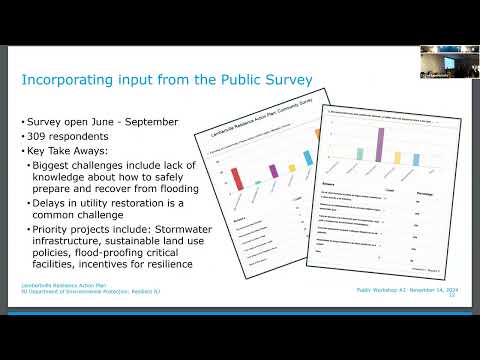
Numbers and sources: Consultants said a June open‑house had about 55 participants and a summer survey (offered in English and Spanish) received over 300 responses. The team described assessing 36 assets and said the project began tracking public engagement in March; they expect to finalize deliverables with the advisory committee and post updates online, aiming to complete work by the end of February.
Voices from the meeting: Shelby Smith, a senior planner with the consultant team Ramble, summarized survey takeaways: “the biggest challenges… include a lack of knowledge about how to personally prepare,” plus anxiety about future impacts and delays in utility restoration. In a station reportback, a facilitator urged coordination with regional entities including canal and watershed authorities to address upstream flows that affect Lambertville.
What’s next: The consultants will synthesize station feedback with an advisory committee, revise the draft actions and publish a final Municipal Resilience Action Plan. Participants were given comment cards, a QR code and an email address to submit additional ideas. The consulting team said their work is on track to wrap up by the end of February.
The meeting closed with thanks to volunteers and municipal staff; no formal votes or policy adoptions were taken at the workshop.