Get Full Government Meeting Transcripts, Videos, & Alerts Forever!
Get email alerts on the Land Use Development topic
No spam. Unsubscribe anytime.
Hearing examiner signals approval for Vmont Place subdivision in Yelm, ties build to gopher conservation and traffic fixes
Summary
Yelm hearing examiner Mark Shipmire said he will approve the preliminary plat for the 150‑lot Vmont Place subdivision but will require written findings and conditions tying construction to a mazama pocket gopher habitat conservation plan and traffic mitigation including sidewalks and a pedestrian beacon.
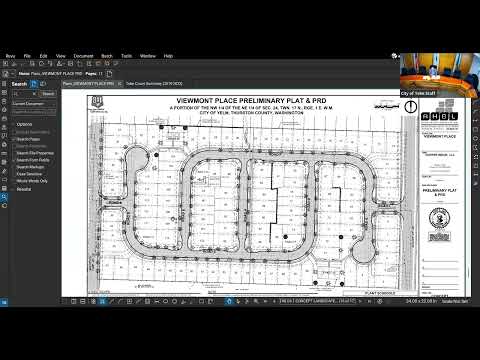
Hearing Examiner Mark Shipmire announced he will approve the preliminary plat for Vmont Place, a proposed 150‑lot subdivision on 19.2 acres at 9410 Mountain View Road in Yelm, saying he will issue written findings and conditions shortly.
Shipmire, who opened the April 2 hearing by telling participants that "this is not a popularity contest," described his role as a fact‑finder applying Yelm’s land‑use rules. He said he had reviewed the staff report and public comments and would set conditions in his written decision to address issues raised in testimony.
City planning staff, represented by Andrew Kohler, told the hearing the applicant had agreed to a key limitation: "the preliminary plat will be approved while prohibiting any site‑disturbing activities until a habitat conservation plan is formally adopted," because the site is known to host a population of mazama pocket gophers. Kohler said the city is drafting an HCP for the species and expects that work to continue into 2027; the city and applicant agreed the plat may be approved now but cleared for ground‑disturbing work only after HCP requirements and mitigation are in place.
Traffic mitigation was another central condition recommended by staff. Kohler summarized the applicant’s Traffic Impact Analysis and agency review, saying required measures include restriping the Mountain View Road/SR‑510 crosswalk, upgrading pedestrian signage to fluorescent school‑zone standards, constructing roughly a 90‑foot sidewalk connection to SR‑510, and installing a rectangular rapid‑flashing beacon at Killian and Coats Road. A traffic‑signal warrant analysis for Mountain View/SR‑510 found a signal not warranted; staff said additional system‑level re‑evaluation will occur after completion of the Yelm Loop project and that coordination with the Washington State Department of Transportation (WSDOT) will be required for certain off‑site improvements.
On utilities and other concurrency requirements, staff said the developer must extend the city water main and sewer so each lot can connect; exact upgrades and stormwater facilities will be determined during civil plan review. Applicant witnesses said a preliminary stormwater report exists and that design uses underground infiltration trenches and treatment vaults to retain and treat runoff on site.
The applicant’s team included developer representatives (Evan Man and Kurt Wilson of Soundbuilt Homes/Copper Ridge LLC) and engineer Scott Call of AHBL. Wilson argued the project would add housing supply and smaller lots to ease affordability pressures; Call described below‑grade infiltration systems and treatment vaults intended to protect the aquifer.
Public testimony ran nearly two hours. Speakers from across the city urged caution about growth, citing traffic congestion on SR‑510/507, school capacity and bus reliability, emergency‑response delays, and a desire by some neighbors to preserve the parcel as open space or community green. Resident Scott Weber and others described existing peak‑hour congestion; multiple speakers asked whether impact fees would be used to fix current infrastructure shortfalls or pay for future improvements. Shipmire and staff explained that school impacts are addressed by an existing concurrency/impact‑fee agreement between the city and the school district and that, as a legal matter, the hearing examiner must accept that mechanism when applying concurrency rules.
Shipmire said he will incorporate the record — including staff’s recommended conditions, the requirement to withhold land‑disturbing work until an HCP is adopted, traffic mitigation measures and the standard conditions for utilities, fire protection and school impact fees — into his written findings and conclusions. He told the room the oral announcement of approval is preliminary and that his formal written decision and findings will follow within the statutory period.
Next steps: Shipmire will issue written findings of fact, legal conclusions and the formal decision (he told participants he expects to have them within about a week, though he has up to two weeks). The decision will specify final permit conditions and the timing for any required mitigation, including the rule that no site‑disturbing work may occur until the city’s pocket‑gopher HCP and associated mitigation are in place.