Get Full Government Meeting Transcripts, Videos, & Alerts Forever!
Get email alerts on the Immigration Enforcement Policy topic
No spam. Unsubscribe anytime.
Cotati City Council weighs steps to shield residents during federal immigration enforcement
Summary
At a May 12 joint meeting, Cotati City staff recommended a resolution reaffirming current practice not to assist federal civil immigration enforcement, exploring an operational response aligned with Sonoma County, and drafting a prohibition on using city property and resources for civil immigration enforcement; public commenters urged stronger protections and community outreach.
Cotati — City staff on Tuesday laid out options for protecting residents if federal immigration enforcement operations occur locally, recommending the council reaffirm existing practices that limit local cooperation, draft a resolution prohibiting use of city property and resources for civil immigration enforcement, and coordinate an operational response with Sonoma County.
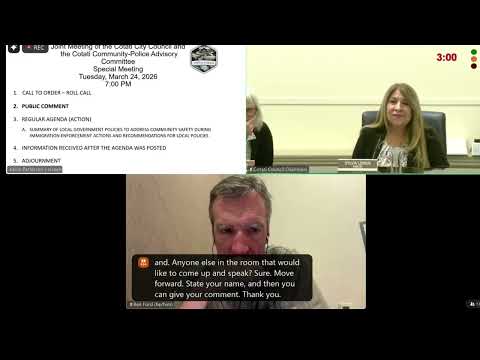
During a joint meeting of the Cotati City Council and the Cotati Community Police Advisory Committee, staff summarized state and regional precedents — including local ordinances and resolutions in Bay Area cities — and advised caution about ordinances that would attempt to restrict federal agents’ access to broadly public areas because they could prompt costly litigation. The meeting drew a large public-comment turnout; several residents and faith leaders urged the council to move quickly and include Spanish-language outreach and clearer community-notification procedures.
Staff framed the issue as twofold: what the city will do (policies and operational posture) and what the city can legally require of federal agents. The city attorney and staff said state laws such as the Values Act and the Truth Act already constrain local law-enforcement cooperation with federal immigration authorities and that some proposed local measures — for example, prohibiting federal use of certain locked municipal areas or posting signage in city lobbies — are generally feasible; other steps, such as blocking access to streets or public parks, present unresolved legal risk and would likely result in federal litigation.
Several residents told the council they fear routine surveillance systems (including automatic-license-plate readers) and asked whether those data are available to federal agencies. Police Chief Simmons said the department’s recent ALPR deployment (Flock) has California-only settings that prevent national or federal lookups, that ALPR data are audited, and that the department does not collect or share immigration-status information.
Council members asked staff to return with a draft resolution that would: (1) reaffirm current practice and applicable state law limiting local cooperation with federal civil immigration enforcement; (2) explicitly prohibit use of city property and resources for civil immigration enforcement; and (3) state the city intent to align any operational response with Sonoma County’s concept of operations so messaging and public-safety actions are regionally consistent. Council members and the chief emphasized that local officers will continue to respond to 911 calls for public-safety reasons, document encounters with body-worn cameras, and refer potential legal violations for further review.
Public commenters urged broader community engagement — particularly outreach to Latinx residents, Spanish interpretation at future meetings, and creation of an alert system to notify residents if federal agents are operating in the area. Several commenters provided model ordinance language compiled from other jurisdictions and a San Jose packet of sample procedures; staff said those materials are included in the meeting packet and will inform the draft returned to council.
Staff warned that ordinances giving the city attorney authority to seek injunctions against federal action could be expensive to litigate and may ultimately be decided in federal court. As a lower-cost alternative with clearer legal footing, staff suggested a city resolution reiterating adherence to state law and refusing use of municipal resources for civil immigration enforcement while continuing to coordinate with county and regional partners.
The council gave staff consensus direction to prepare a draft resolution and related materials for a future meeting; no ordinance or formal vote was taken at Tuesday’s session. The meeting adjourned with staff committed to return with a draft for council consideration.