Get Full Government Meeting Transcripts, Videos, & Alerts Forever!
Get email alerts on the Zoning Home Occupation topic
No spam. Unsubscribe anytime.
Salem committee debates home‑occupation zoning changes; matter remains in committee
Summary
Salem City Council’s ordinances committee reviewed a draft to clarify what home‑based businesses may do, debated enforcement and specific prohibitions such as barber shops, and voted to keep the proposal in committee while staff answer detailed implementation questions.
The Salem City Council ordinances committee on April 14 reviewed a draft amendment to the city’s home‑occupation zoning rules and voted to keep the measure in committee so department heads can respond to technical questions.
The session began with a presentation of a draft ordinance and comparative language from other Massachusetts municipalities. The presenter said the version before the committee is intentionally more specific than prior, vaguer drafts and drew on guidance from the American Planning Association to explain common municipal standards and tradeoffs.
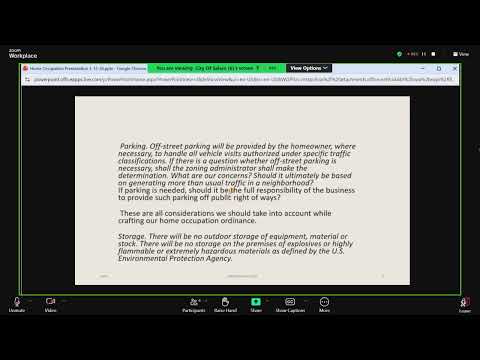
“Residents need to know where they stand,” the presenter said, urging a ruleset that lets reasonable uses proceed by right rather than force residents to seek special permits. The presentation listed typical standards—no exterior evidence of business, no odors or noise beyond the property line, off‑street parking when needed, no outdoor storage of hazardous materials—and noted that the draft would be a zoning change for Salem, which contains many nonconforming residential uses in business districts.
Councelor King said she supported the proposal’s economic intent, citing recent local microbusiness support and saying home occupations can incubate small, often women‑ and minority‑owned enterprises. “I saw some data from the Northshore Community Development Coalition … they supported something like 65 micro businesses this year in Salem,” Councelor King said.
Other councilors pressed implementation details. Councelor Tapworth and several members said the building inspector, the city solicitor and the health agent should be asked how the draft would be enforced and whether existing codes (for example, the state’s cottage‑food rules) already address some activities. “I think the building inspector needs to be here before we can get into any understanding of what this language should look like,” Councelor Tapworth said.
Councilors voiced practical concerns about specific provisions in the draft. Multiple members questioned the enforceability of a 25% floor‑space cap, whether listing many specific permitted professions (for example, naming particular licensed professionals) is preferable to a broader “licensed professionals” approach, and whether certain uses such as barber shops or small personal‑service operations should be prohibited outright or regulated through nuisance and assembly limits.
Public comment was limited. Jeff Cohen of Hancock Street urged the committee not to allow barber shops near his neighborhood and recommended the health agent be part of future discussions regarding food preparation and safety.
On procedure, the committee debated a motion to “remain in committee” so staff could be invited and given questions in advance. An early vote produced procedural confusion and an initial tally that did not carry; after the committee compiled questions and agreed to invite department heads to the next meeting, a subsequent motion to keep the item in committee carried by roll call. A final motion to adjourn carried and the meeting ended.
What happens next: the committee chair said she will compile the questions raised at the session and send them to relevant department heads (building, health, city solicitor, and parking/traffic) so staff have time to prepare for a future meeting where technical details, enforcement mechanisms and draft language can be debated further.
The committee did not adopt any ordinance language at the April 14 meeting; the item remains in committee pending staff responses and further drafting.