Get Full Government Meeting Transcripts, Videos, & Alerts Forever!
Get email alerts on the Flood Warning Systems topic
No spam. Unsubscribe anytime.
Upper Guadalupe Authority says siren rollout, gauges and dashboard on track; initial siren phase targets West Kerr County camps
Summary
Upper Guadalupe River Authority officials told Kerr County commissioners the SB3‑funded flood warning system is moving quickly: vendors and engineering are selected, initial siren purchases are underway and a public dashboard and predictive modeling are expected this summer. Officials emphasized coordination on siren placement and longer‑term operation agreements.
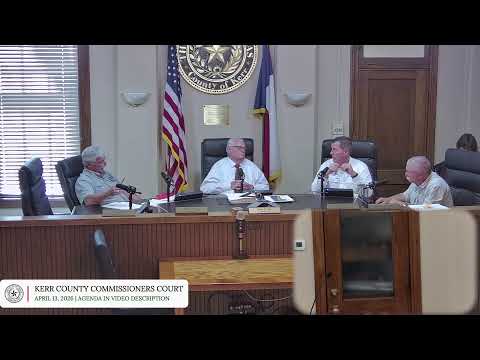
Upper Guadalupe River Authority staff told Kerr County commissioners on April 13 that work to implement a countywide flood‑warning system funded under Senate Bill 3 is progressing and that an initial phase of siren installations is already under way.
"That initial phase is underway," Tara Bushnau, a UG representative, told the court. She said the project team has selected West Consultants as the engineering lead, has procured Federal Signal sirens and Omniorn services for alerts and software, and is coordinating a private LTE network to carry sensor and siren telemetry. Bushnau said UG plans to bring a public data dashboard and predictive modeling online in summer 2026 and expects new USGS stream‑flow and rainfall gauges to begin reporting at five‑minute intervals.
The update focused on near‑term deployments in west Kerr County where campgrounds and recreation sites sit close to fast‑responding waterways. Bushnau said the initial SB3 funds cover professional services, site work and the purchase of equipment. She told the court the initial implementation phase is scheduled for May and that UG will return to the court with a proposed agreement to define long‑term operation and maintenance responsibilities within about six months.
Commissioners pressed staff on siren placement and the interaction between state mapping and local knowledge. Bushnau noted that SB3 requires maps showing flash‑flood risk areas and said the state process is one factor for where sirens might be required; she added local input is essential to avoid installing hundreds of sirens in impractical locations. "We can target no‑brainer locations now," she said, while preserving the opportunity to refine placement as work continues.
County staff and commissioners also discussed the technology and funding timeline. Bushnau said LC (the broadband middle‑mile awardee) has begun building infrastructure used by the sirens and that UG selected Grant Works to manage the SB3 grant administration. She said the county should expect to see eight sirens purchased and installed during the initial phase using the $1.25 million currently available, with requests for additional funding to extend coverage.
Why it matters: Kerr County flood‑warning improvements are intended to reduce loss of life and property by giving residents, campers and visitors earlier, site‑specific warnings. The combination of sirens, a public dashboard, faster remote gauges and predictive modeling is designed to speed emergency response and licensing of vulnerable campgrounds.
What's next: UG will continue site visits, finalize civil and structural engineering, and coordinate public outreach. The authority plans to present a draft agreement on operations and maintenance to the Kerr County Commissioners Court within about six months, and staff asked commissioners to supply local placement input for the initial siren phase.