Get Full Government Meeting Transcripts, Videos, & Alerts Forever!
Get email alerts on the Telecom Policy topic
No spam. Unsubscribe anytime.
Board adopts updated communication‑tower rules, widens setbacks and strengthens notice and RF checks
Summary
After hours of public testimony from residents and telecom representatives, the Board adopted amendments to the county's Communication Towers and Facilities Ordinance. Changes include larger 150% height setbacks, expanded neighborhood notice requirements, post‑installation RF verification, maintenance and decommissioning language, and an applicability carve‑out for pending applications.
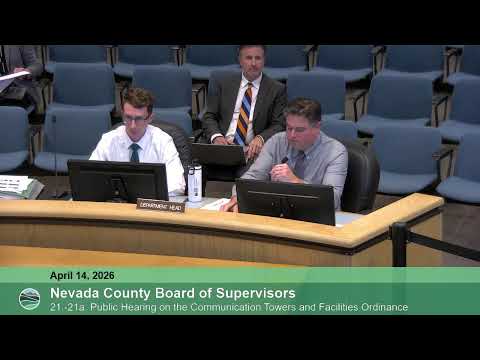
The Board of Supervisors voted April 14 to adopt a substantial update to Nevada County's Communication Towers and Facilities Ordinance (CTFO), after a lengthy staff presentation, planning commission review and a public hearing that drew dozens of speakers representing neighbors, advocacy groups and telecom firms.
Associate Planner David Nicholas told the board the update aims to modernize definitions to align with FCC terminology, tighten application requirements and public notice, and reduce visual and maintenance impacts while still enabling broadband expansion. Major provisions adopted include a formulaic setback requirement (setback of 150% of tower height from property lines), a neighborhood notice requirement before an application is filed (approximately 1,000 feet), codified RF exposure reporting and a new requirement for post‑installation RF verification in the field, and explicit facility maintenance obligations including a condition requiring removal within 12 months of abandonment.
Nicholas said small wireless facilities ("small cells") under the new text are exempt from county land‑use permits but remain subject to building permits and RF compliance rules; staff explained this exemption reflects existing practice for minor antennas and federal/state constraints on small‑cell regulation. The planning commission had recommended adoption while asking staff to consider stronger RF monitoring and to clarify how the code applies to pending applications.
The hearing produced sustained public comment. Nevada County for Safe Tech (NCST) and multiple residents urged stronger protections: a CUP requirement for small cells, independent and periodic RF testing, larger setbacks (500–1,000 feet in some areas), a formal waiver process and detailed fire‑safety and decommissioning plans. Telecom representatives and a telecommunications attorney warned that overly large setbacks or blanket requirements could make towers infeasible countywide; a Verizon representative said a 150% setback proposal would render most county parcels unavailable for new wireless sites.
After discussion the board adopted the ordinance with a targeted modification to the applicability language: applications deemed complete before the ordinance's effective date will follow the prior standards; applications filed before but not deemed complete as of the effective date will be subject to the new provisions except the new setback requirement will not be retroactive to those pending incomplete applications. The board also asked staff to add clearer language requiring fire‑safety documentation and plain‑language notices for affected pending applicants.
What happens next: the amended CTFO becomes effective after the standard ordinance effective period. Staff will publish a plain‑language explanation for applicants and notify existing applicants about which rules apply to their cases; future applications will follow the new ordinance requirements and related technical checklists.