Get Full Government Meeting Transcripts, Videos, & Alerts Forever!
Get email alerts on the School Construction topic
No spam. Unsubscribe anytime.
Presenter: New Medford high school plan would make pool a separate, local expense; modulars and high-rise rules drive costs
Summary
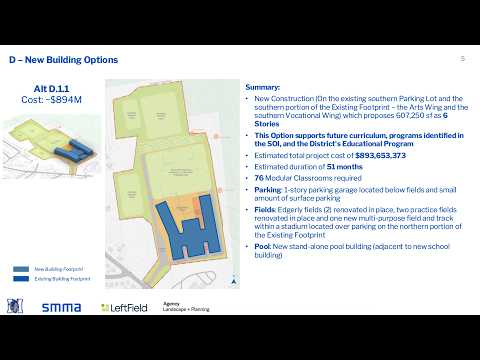
A presenter told Medford Public Schools that a new-build Option D would require a pool to be a standalone project with separate procurement and a separate debt-override vote and that MSBA will not cost-share the pool; modular classrooms and high-rise code requirements were identified as major cost drivers.
A presenter outlining Option D for the Medford Public Schools high school rebuild said the plan would treat a new pool as a separate project that the state school building authority will not cost share, making the pool a Medford-only expense.
“The pool, if we're going to build it new, has to be a separate standalone project and building from the high school building,” the Presenter said, adding that a standalone pool requires separate public procurement and separate mechanical and electrical systems. The Presenter also said any debt override for the pool would need voter approval as a distinct ballot question from the high school project.
The Presenter confirmed that “the MSBA will not cost share for the pool,” meaning the town would fund the pool construction and related systems without state reimbursement. That carries budgetary implications because the rebuilding option labeled D overlaps parts of the existing building footprint, which increases the number of temporary modular classrooms required during construction.
The presentation explained why modular-classroom counts rise: Option D impacts the B-wing and portions of the vocational wing, forcing more programs into temporary space while construction proceeds. The Presenter said attempting to site the entire new building on the parking lot to eliminate modulars would instead require a much taller structure — adding stories — and would trigger high-rise building-code requirements that raise construction costs.
“You just think about building a high-rise building, it becomes a little bit more expensive,” the Presenter said, noting code-driven premiums for smoke-evacuation systems and reinforced stairwells required above roughly four stories.
The Presenter also flagged a design choice in the option: a synthetic turf field over parking, which contributes to higher costs. As an alternative to cut expense, the team suggested returning to surface parking and allocating the field elsewhere on the site.
No formal votes or decisions on Option D or a separate pool debt question were recorded in the transcript. The presentation identified the separate cost, procurement, and voter-approval requirements for a new pool and highlighted modular-classroom needs and high-rise code as principal cost drivers for the proposed new-construction option.