Get Full Government Meeting Transcripts, Videos, & Alerts Forever!
Get email alerts on the City Budget topic
No spam. Unsubscribe anytime.
Seal Beach officials say city is fiscally stable at midyear but warn of sales-tax and inflation risks
Summary
Finance director told the council the city remains fiscally stable at midyear with property tax and recreation fees holding up, but slower consumer spending, sales-tax softness and global uncertainty (including Middle East events and LA28) pose downside risks; council asked staff to model contingency steps and consider one-time pension prepayments.
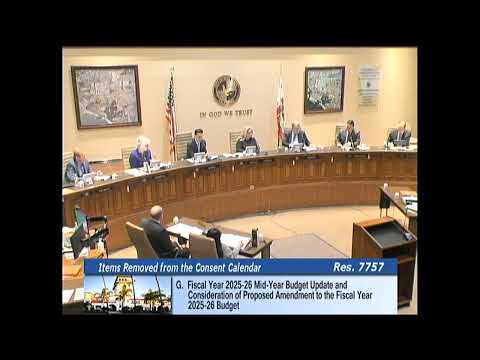
Seal Beach’s finance director told the city council on April 13 that the general fund is stable at the midyear point but faces rising downside risks from slowing consumer spending and broader geopolitical uncertainty.
In a detailed midyear presentation, Director of Finance Aronado said property tax — the city’s largest revenue source at about 34% of the general fund — is slightly above budget and remains the most reliable revenue stream. Charges for services, notably recreation programs and pickleball/tennis activity, have exceeded expectations, while transient occupancy tax (TOT) performance is steady based on the city’s three hotels.
But sales tax was the presentation’s primary caution. Aronado said fourth-quarter receipts were down from the prior year, driven by lower receipts in some business sectors and reporting aberrations; January data improved and helped align projections back to budget. Staff are tracking sales-tax trends monthly with consultant HDL and CDTFA data and said they will bring near-term adjustments if the deterioration continues. Aronado also flagged inflationary pressures, rising construction and healthcare costs, and the possible economic effects of international conflicts as factors to watch.
Council members pressed staff on how quickly the city could respond if revenues dipped. Aronado described the financial monitoring cadence: month-close and quarterly reviews, consultant projections, and a city financial model that allows scenario planning. Near-term actions would prioritize public safety and could include hiring freezes, position holds, expenditure reductions and CIP adjustments — measures the city used during earlier downturns.
Councilmember discussion also touched on the use of one-time midyear funds. Staff noted the city has made two discretionary pension prepayments in recent years that reduce long-term CalPERS liability and that additional targeted prepayments can yield recurring savings; council asked staff to return cost and timing options for a potential $250,000 prepayment and for scenarios that would dedicate onetime funds toward the lifeguard headquarters project.
The council received the midyear report and approved the staff-recommended budget amendments. Staff will continue monthly monitoring and return to council with follow-up options as projections evolve.
Speakers quoted or referenced in this article are drawn from the council meeting transcript and include the Director of Finance (Aronado) and multiple council members.