Get Full Government Meeting Transcripts, Videos, & Alerts Forever!
Get email alerts on the Graduation Requirements topic
No spam. Unsubscribe anytime.
Modesto board narrows graduation requirements, adds ethnic studies and approves continuation and adult‑ed changes after lengthy debate
Summary
After hours of debate on equity and practical coursework, the Modesto City Schools board approved changes that add a required ethnic studies semester, move world geography/religions into electives, and lower some credit totals for continuation and adult education programs. Trustees split 5–2 on the comprehensive policy and voted separately on continuation and adult‑ed rules.
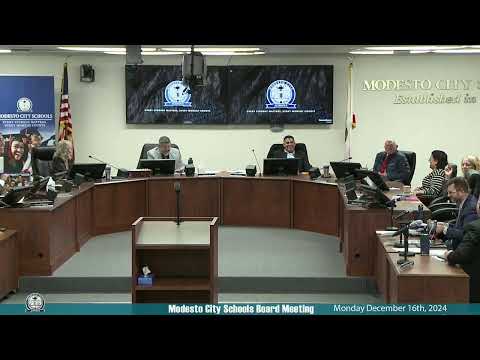
The Modesto City Schools Board of Education approved a set of revisions to district graduation policies on Dec. 16, following multi‑hour discussion about equity, English‑learner course loads and career‑focused alternatives.
The board voted 5–2 to adopt the comprehensive high school policy language that codifies earlier decisions to require a one‑semester ethnic studies course for incoming ninth graders, move world geography/religions into the elective bucket, and reduce the district's overall credit requirement from 230 to 220. Vice President Miestas moved the motion; Trustee Brown seconded it. Trustees Daly and Marks voted no.
Why it matters: Board members said the changes are intended to remove barriers for students who are locked into required English‑learner coursework and to broaden options for students to pursue electives, CTE and other pathways. Advocates said the ethnic studies requirement will start with a pilot for the incoming ninth‑grade cohort and be implemented districtwide in the following year.
Board debate focused on several points. Trustee Marks said he remained "passionate about world religions" and worried that removing it as a requirement would reduce curricular exposure; he proposed restoring world religions as an elective requirement but did not win a majority. Other trustees pressed for data modeling to estimate how many additional students might be able to graduate with lowered credit totals.
On continuation high school requirements (the district's Elliott program), trustees agreed to a revision that reduces the mathematics requirement from three courses to two (20 units) and reallocates 10 units to electives so the total continuation requirement will be 190 units; the board approved that change unanimously after trustees asked staff to develop more practical‑math and personal‑finance options tailored to continuation students.
On adult education, trustees voted 4–3 to align the adult‑education diploma to state minimums (135 units) while adding language to accommodate the newly required ethnic‑studies unit where applicable. Trustee Brown moved the adult‑education motion and Vice President Miestas seconded; Trustees Marks, Lopez and Daly voted no, citing concerns about maintaining extra English instruction and elective opportunities for adults who return to complete diplomas.
Trustees and staff agreed on next steps: staff will return revised policy language for final adoption with the edits directed during the meeting, provide requested data projections on the potential enrollment and graduation impacts, and continue the ethnic‑studies pilot. Superintendent Dr Naguchi and staff emphasized the implementation timeline: most changes take effect for the current year, while the ethnic‑studies requirement will roll out with the incoming ninth‑grade class after the pilot.
Votes and formal actions: The board voted separately on the three policy areas so each could reflect different trustee guidance. The comprehensive high school policy was approved 5–2 (Nays: Daly, Marks); the continuation policy passed unanimously after numeric adjustments; the adult education policy passed 4–3. The board directed staff to return revised drafts reflecting the meeting’s guidance and to provide data on projected graduation impacts.
The board closed the policy discussion by reiterating that the district must balance higher academic aspirations with pragmatic pathways for students who face scheduling constraints (including many English learners) and for adults returning to complete a diploma. Staff members said they will return in January/February with updated language and supporting projections.