Get Full Government Meeting Transcripts, Videos, & Alerts Forever!
Get email alerts on the Mailed Taxpayer Statement topic
No spam. Unsubscribe anytime.
State explains mailed property-tax statement, March 5 and March 15 deadlines
Summary
Department of Management presenters explained the content and timing of the new mailed taxpayer statement, showed how the mandated residential and commercial examples are calculated, and reminded county auditors that data must be proposed in the state system by March 5 (4 p.m.) and mailings completed by March 15.
The Department of Management told county auditors in a budgeting webinar that every county must include city, county and school rate and dollar information on a state-prescribed mailed property-tax notice and that the data feeding that mailer must be proposed in the state system by March 5 at 4 p.m. Counties must send the mailings to taxpayers by March 15.
The mailer is a single two-sided page containing on the front the local entities—s current and proposed rates and dollars, and the time, date and location of a separate property-tax hearing. The back shows a mandated example and a table breaking down the percentage of current-year property taxes going to each levy authority (TIF and non-TIF totals). "This is a specific example to that exact property value; it—s not tailored to each taxpayer," a presenter said, explaining the mailer uses the same assessed-value example for every recipient and pointing auditors to an online tool where taxpayers can run tailored estimates.
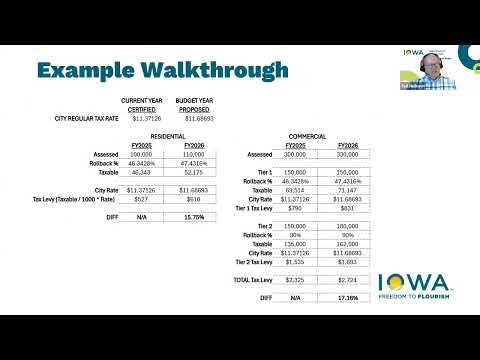
Presenters described a recent change to the mandated example: the residential example now uses a $100,000 current-year assessed value and a $110,000 budget-year value (a 10% increase), and the commercial example uses $300,000/$330,000. The webinar walked auditors through the arithmetic: apply the appropriate rollback percentage to assessed value, divide by 1,000, apply the tax rate, and—for commercial properties—compute two tiers (the first $150,000 receiving the residential rollback, the remainder rolled back at 90%). To compute the percent change between years, subtract the current-year amount from the budget-year amount and divide by the current-year amount.
State staff warned counties not to allow local governments to insert additional materials into the mandated mailing. If a city or county wants to provide explanatory text, the presenters said, it must be sent as a separate mailing done by that local government, not inserted in the state mailer.
Auditors were shown how to download county-specific mailing data from the state system as a CSV. The state will run a backup of all counties on March 5 to adjudicate disputes if needed. This year the export will label each line with the levy authority type (for example "City of..." or "School of...") so cities, counties and schools are distinguishable in the download; if a local government failed to submit required notice information, its line will be blank and the mailer will include a notation that the local government did not submit its hearing information on time.
The presenters also stressed publication obligations that are separate from the mailer: local governments must publish or post notice of the property-tax hearing not less than 10 nor more than 20 days before the hearing (smaller cities may post in three public locations instead). The property-tax hearing must be a standalone agenda item; no other local-government business may be conducted at that hearing.
The session closed with a reminder that proof of proper mailing from the county—s contractor is sufficient if a taxpayer later claims nonreceipt; the existence of required publication or mailing records does not typically invalidate the process if records show compliance.