Get Full Government Meeting Transcripts, Videos, & Alerts Forever!
Get email alerts on the Regional Transportation Plan topic
No spam. Unsubscribe anytime.
Metro begins scoping for 2028 regional transportation plan amid funding uncertainty
Summary
Metro staff told the C4 Metro subcommittee they are in phase one of the 2028 Regional Transportation Plan scoping, seeking early input on goals, measures and engagement. Elected officials pressed staff on declining transit funding, the need to include smaller transit providers and freight access concerns.
Metro staff briefed the C4 Metro subcommittee on April 15 that they have entered the scoping phase of the 2028 Regional Transportation Plan update and aim to deliver an adopted plan by Nov. 30, 2028.
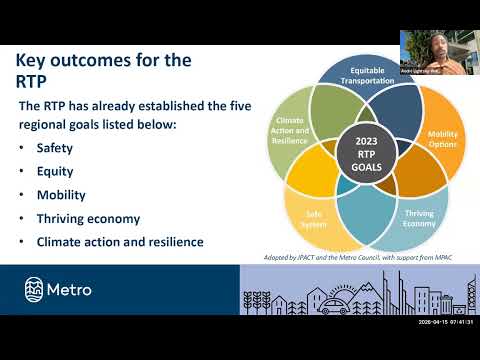
The update team, led by Andre Lacy Walker and Camela (regional transportation planning manager), said phase one runs through July 2026 and focuses on finalizing a work plan and engagement plan, reviewing goals and measures of success, and identifying performance targets and revenue forecasts. Staff said projects must align with RTP goals and performance measures to be eligible for state and federal funding and noted several locally preferred alternatives will be placed into the amended 2023 RTP to preserve eligibility for future funding.
Why it matters: The RTP sets regional investment priorities that influence which projects can compete for federal and state dollars. Staff warned of current revenue uncertainty, reduced transit funding in parts of the region and persistent safety and climate challenges that will shape trade-offs in the update.
Key details: Walker described a multi-phase process that includes a call for projects, project and performance analysis, a 45-day public comment period on a draft plan and a preliminary approval step intended to allow time for final public review before legislative adoption. Staff showed interactive maps and noted that the 2023 RTP had anticipated about $69.3 billion in spending, with most projects under $25 million and a few above $1 billion.
Engagement approach: Alfredo Haro, Metro's engagement lead for the RTP update, described a strategy emphasizing neighborhood-level outreach, partnerships with community organizations and narrative/digital engagement tools. Haro said technical work groups will be engaged for revenue forecasting and that staff are tracking travel into the Metro region from communities outside the jurisdictional boundary.
Elected officials' concerns: Committee members asked how Metro will account for reduced transit operations funding and whether staff will engage state legislators about funding futures. Several members — including Mayor Milch and Commissioner Savis — urged Metro to broaden outreach to smaller, non‑TriMet transit providers and jurisdictions beyond Metro boundaries so providers that actually deliver service in outlying commute sheds are represented during planning. Another member noted freight access received less than 1% of project funding in the statistic cited by staff and urged a stronger economic focus and clearer metrics for return on investment.
Next steps: Staff said they will seek feedback on a draft work plan and engagement plan in June and aim to take those plans to TAC, JPAC and Metro Council in July for formal consideration. A TAC workshop is tentatively scheduled for the morning of June 10 to dig into technical questions and trade-offs.