Get Full Government Meeting Transcripts, Videos, & Alerts Forever!
Get email alerts on the Election Security topic
No spam. Unsubscribe anytime.
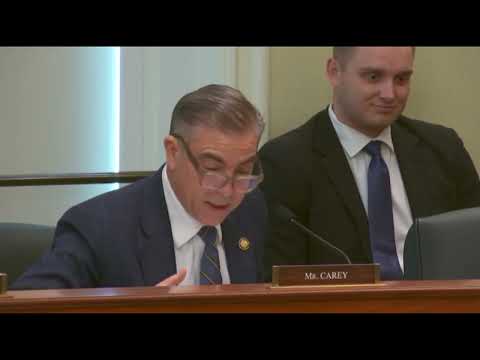
Rep. Carey backs H.R. 7300; Kansas secretary says voter ID didn’t block access
Summary
Rep. Carey told the House Administration committee he is an original co‑sponsor of H.R. 7300, proposing mandatory photo ID, citizenship checks, paper ballots and routine voter‑list maintenance; Kansas Secretary Schwab said the state’s ID law included a free‑ID affidavit and had not prevented voting.
Representative Carey (R-Ohio) told the House Administration Committee that he is an original co-sponsor of H.R. 7300 and described the bill as a set of election‑security measures that would require photo identification, citizenship verification, use of paper ballots and regular voter‑list updates.
Carey said the proposals reflect concerns ahead of state primaries and the general elections and pointed to Kansas as an example of an implemented ID law. "I AM AN ORIGINAL CO‑SPONSOR OF HR 7300, WHICH DIRECTLY ADDRESSES THESE CONCERNS,” he said, listing mandatory photo identification, citizenship verification, paper ballots and routine updates to voter rolls.
Carey thanked state officials including Ohio Secretary Frank LaRose and praised what he called strengthening election integrity efforts by officials such as Kansas’s Secretary Schwab.
When asked whether Kansas’s voter‑ID requirement had been a barrier to voting, Secretary Schwab replied, "NO. AND THE ONLY BARRIER THERE WAS, UH, WE HAD TO PROVIDE A FREE ID, SO WE HAVE SOMEONE SIGN AN AFFIDAVIT SAYING I CAN'T AFFORD AN ID AND THE COUNTY WILL ISSUE THEM." He described that provision as part of why the law became bipartisan.
On the cost to individuals, Schwab said people who sign the affidavit receive the ID at no charge. "THEY GET IT FREE," he said, adding that the required ID must be government‑issued and contain the holder’s name and photograph. He said the card does not need a signature and that, in practice, a driver's license is used in most cases.
Schwab related an anecdote from the state process in which a voter discovered he had voted in school board elections for years without being asked for ID; Carey said that example helped secure minority‑party support for Kansas’s law.
When Carey asked whether enacting a voter‑ID requirement for federal elections would boost public confidence, Schwab said it already had in Kansas. The exchange in this transcript did not include a committee vote on H.R. 7300 or any formal action recorded in the hearing excerpt.
The committee record in this transcript contains no formal motion or recorded vote on H.R. 7300.