Get Full Government Meeting Transcripts, Videos, & Alerts Forever!
Get email alerts on the Government Operations topic
No spam. Unsubscribe anytime.
Guam lawmakers spar over expanding procurement training to University of Guam; critics warn of curriculum fragmentation
Summary
The committee heard two bills to expand procurement training: Bill 301-38 would add the University of Guam as an authorized provider alongside Guam Community College; Bill 300-38 would overhaul training requirements and require articulation agreements. Supporters cited capacity gaps; critics warned that permitting UOG to run a separate program without a required coordination agreement risks inconsistent curricula and procurement protests.
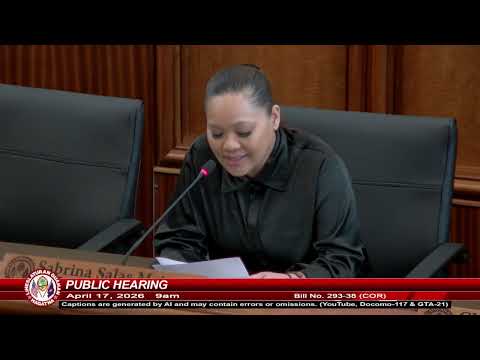
The Committee on Finance and Government Operations on April 17 heard competing and complementary proposals to expand procurement training for government employees, bills intended to reduce procurement delays and protests by increasing certified staff.
Bill outlines and proponents
Senator Christopher M. Duenius introduced Bill 301-38 to allow the University of Guam (UOG) to serve alongside Guam Community College (GCC) as an approved provider of the government’s procurement training and certification program. He said the change is intended to "expand access" and relieve bottlenecks where demand for modules has outpaced capacity.
Dr. Ricky Hernandez, UOG’s vice president for administration and finance, testified that the university "is in full support of bill 301-38" and described institutional capacity in adjunct instructors, administrative infrastructure, and existing certificate-delivery units that could administer the program and coordinate with the Guam Procurement Advisory Council.
Bill 300-38, introduced by Senator Perez, proposes a broader overhaul: sequential module requirements, a new practical-application module, continuing education every five years, and explicit language authorizing articulation agreements so GCC and UOG harmonize curricula. Its stated aims are more uniform training, increased availability, and fewer protests.
Debate: capacity versus consistency
Lawmakers broadly agreed additional training capacity is needed. Supporters cited student research that flagged scheduling and capacity constraints and said multiple providers could speed certification. Opponents and some procurement officials warned that allowing two independently administered certification tracks could fragment curriculum and interpretation, exacerbating rather than reducing protests.
"If there's no consistent curriculum it's really setting us up for protest," said one senator questioning the measures. Senators requested either mandated articulation agreements or stronger statutory language requiring consultation with the Guam Procurement Advisory Council to ensure uniform standards and to prevent inconsistent instruction across agencies.
Instructor qualifications, accreditation and fees
Committee members asked how instructors would be qualified and whether certifications such as CPPO/CPPB (certifications under national procurement bodies) or NASPO/NIGP training would be required or accepted. UOG said certification programs live within its global learning and engagement unit and that the university can administer non-degree certificate programs; it proposed using articulation agreements and council consultation to ensure reciprocity of modules and credit transfer.
Next steps and process
The committee did not vote on either bill during the hearing. Senators requested additional written testimony and signaled intent to hold follow-up oversight or roundtable sessions with the Guam Procurement Advisory Council, GCC and UOG to resolve curriculum harmonization, instructor qualifications and program sequencing before moving either measure forward.
The record remains open for 10 calendar days for written testimony.