Get Full Government Meeting Transcripts, Videos, & Alerts Forever!
Get email alerts on the Grants Trauma Informed Policing topic
No spam. Unsubscribe anytime.
Urbana to use roughly $90,000 grant to expand trauma-informed policing and partner services
Summary
City officials described how a TACTIC SI grant will fund trauma-informed training, officer wellness and community partners; council members pressed staff for measurable outcomes and asked that grant terms and metrics be provided before final budget acceptance.
Urbana officials described plans to use a roughly $90,000 grant over two years to fund trauma-informed response training, officer wellness and partnerships between the Urbana Police Department and local service providers.
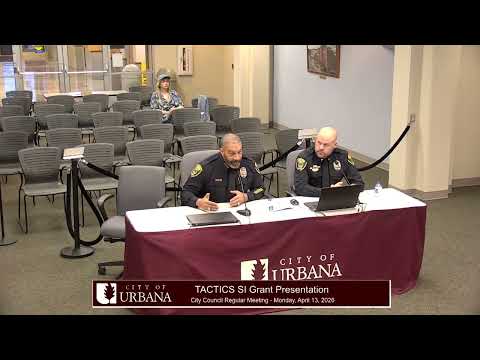
The presenter told the City Council the Total Access Collaborative for Trauma‑Informed Care Statewide Initiative (TACTIC SI) grant will support UPD and community partners with the goal of strengthening trauma‑informed responses and improving access to services. The presenter said two‑thirds of the funds (about 66%) will go to community partners and one‑third will be used by UPD for training, officer wellness and department infrastructure.
In the presentation the council was given a planned distribution that the presenter described as: $30,000 to an organization identified as Dream (roughly 33% of the total), $10,000 to Courage Connection, $10,000 to Urbana Neighborhood Connection Center (UNCC), $10,000 to the Champaign County Children’s Advocacy Center, and about $30,000 retained for UPD programming. The presenter said UPD uses would include trauma‑informed response training, de‑escalation and domestic violence awareness, partnership development and modest infrastructure or data improvements for coordination and referrals.
Council members pressed staff on two procedural points: whether community partners were selected through a public application and how the city will measure success. One council member asked, “Was there a public process where any organization could apply to be a part of this program?” The presenter responded, “There was no process,” and explained partners were selected based on existing, actionable relationships and their ability to work with police.
On metrics, the presenter said the grant’s minimum reporting requirement is raw referral counts and that the agency already required sworn personnel to complete an annual trauma‑informed training course. The Chief of Police said, “I am the chief of police. That’s what I measure,”—explaining that crime statistics and community relations are among the chief’s measures—while council members requested additional program‑level measures that would indicate reduced trauma or improved outcomes.
Staff told the council the Grants/Community Development office will partner with UPD in overseeing distribution and recordkeeping; council members requested to see the full grant agreement and any program metrics before the council takes any formal action to accept and budget the award.
Next steps: staff will provide the grant agreement and detail on reporting and oversight; the council must formally accept the grant and add the funds to the city budget before the money can be expended.