Get Full Government Meeting Transcripts, Videos, & Alerts Forever!
Get email alerts on the Land Development Code topic
No spam. Unsubscribe anytime.
Palm Coast planning board reviews Chapter 2 code amendments tightening review timelines and neighborhood‑meeting rules
Summary
Staff proposed a bundle of Chapter 2 edits to the Land Development Code to reflect recent state statute changes and the city’s updated comprehensive plan — including administrative approval of final plats, standardized 14‑day public‑notice windows, written waiver rules for neighborhood meetings and statutory deadlines for application completeness and approval.
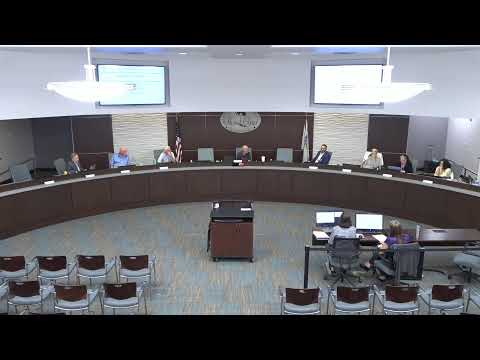
Jose Papa, representing the Community Development Department, presented a set of proposed amendments to Chapter 2 of Palm Coast’s Land Development Code to align local procedures with recent changes to the comprehensive plan and Florida statutes.
The package updates Table 2.1 to reflect review tiers (administrative, planning board, council), clarifies terminology for site plans and plats and removes the requirement that final plats automatically go to City Council now that state law permits administrative approval. "Jose Papa for the Community Development Department," he said when introducing the item and explained staff’s intent to reduce repetitive issues encountered during development review.
Why it matters: the changes shift administrative burden and shorten some formal timelines. Staff highlighted statutory deadlines: applicants must be notified within five business days of receipt whether an application has been logged; staff must determine completeness within 30 days; applications handled administratively must be approved, approved with conditions, or denied within 120 days; matters requiring board or council action must be resolved within 180 days. Staff said the code changes are intended to codify those state timeframes and to put the onus on applicants to request extensions when needed.
Neighborhood meetings: a substantial portion of discussion focused on neighborhood‑meeting procedures. Staff proposed that applicants hold meetings at least 14 days before the first step of review and that notices be postmarked at least 15 days before the meeting so recipients receive them roughly 10 days prior. Board members pressed staff to remove ambiguous wording — for example, the phrase "held or scheduled" — and to ensure waiver requests for neighborhood meetings must be in writing and tied to a prior meeting (rather than allowing broad, verbal waivers). Staff agreed to revise the draft to require written waiver requests and to clarify that a waiver should be grounded in the fact a prior meeting was already held.
Other clarifications and processes: staff explained that multi‑family site plans up to 40 units would be handled administratively, projects between 40 and 100 units would be reviewed by the planning board, and projects above 100 units would proceed from planning board to council. The draft also clarifies that certain "egregious" or typically prohibited uses would proceed via a special‑exception process and require a supermajority vote of City Council. Staff further clarified replat and subdivision terminology to match state statute numbering and noted administrative approval of some plat types.
Expiration and entitlements: for MPDs (master planned developments) staff recommended that development agreements may expire (commonly five years) while the MPD zoning would remain in place; expiration of the development agreement would require a new agreement and a refreshed public‑hearing process for entitlements and conditions.
Next steps: staff will present Chapter 2 to City Council (staff cited a May 12 council presentation), plan a wrap‑up workshop for the Planning Board in mid‑June, and hold a public hearing on the full package in July.
Meeting outcome: there were no public speakers on Chapter 2. The board compiled comments and no final ordinance vote was taken at this meeting; the board moved on to Chapter 12 (signs) after staff closed public comment.
Ending: the meeting proceeded to the next agenda item and later adjourned after a board motion.