Get Full Government Meeting Transcripts, Videos, & Alerts Forever!
Get email alerts on the Medicaid Conformity topic
No spam. Unsubscribe anytime.
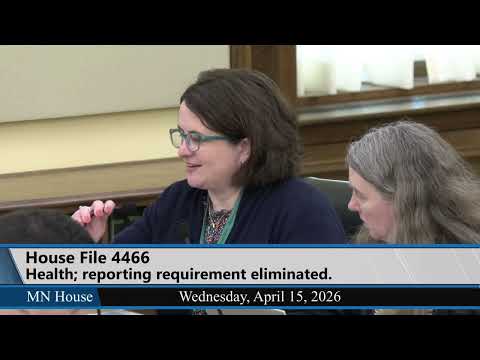
House committee advances health supplemental (HF 4466) amid sharp debate over Medicaid work requirements and hospital funding
Summary
The House Health Finance Committee adopted a DE1 amendment and referred House File 4466 to Ways and Means after testimony warning that HR 1‑related work requirements and shorter retroactive eligibility would increase uncompensated care and harm immigrants, while lawmakers and staff argued implementation and federal‑conformity limits constrain options.
The House Health Finance Committee advanced House File 4466, the health supplemental budget bill, on a voice vote of the committee after adopting a DE1 amendment and subsequent votes on floor amendments; the full bill was referred to the Ways and Means Committee by roll call (reported 14 ayes, 8 nays). The DE1 package includes multiple technical and policy changes, many intended to conform state rules to federal HR 1 requirements affecting Medicaid eligibility, work and community engagement, and data sharing.
Why it matters: Committee witnesses — including legal‑aid advocates, patient advocates and the Minnesota Hospital Association — warned that shortening retroactive eligibility from three months to one month for some groups and imposing HR 1 work requirements for adults without children could increase uncompensated care, complicate hospital billing and create coverage gaps for vulnerable people, including lawfully present immigrants and medically frail patients.
Staff and content: Nonpartisan staff walked members through a detailed spreadsheet showing fiscal impacts the bill would have on the general fund and departments; staff flagged that the largest portions of projected savings come from changes tied to HR 1 affecting adults without children and that implementation will require additional FTE, IT work and county coordination. Staff also reviewed DE1 articles from House Research, which package dozens of sections drawn from multiple bills into the amendment.
What witnesses said: "The work requirements that were passed by HR 1 will have devastating consequences on our clients," said Mr. Knox of Legal Aid, urging clearer exemptions and warning that shortening retroactive coverage will force people to seek care while uninsured. Michelle Benson of the Minnesota Hospital Association told the committee that "shortening retroactive eligibility will leave hospitals with more uncompensated care" and described county backlogs and billing delays she said already leave newborns and children waiting more than 30 days for enrollment in some counties.
Data access amendment adopted: Representative Elkins successfully offered an amendment (A1) to provide a $55,000 General Fund appropriation to allow the Department of Health to incorporate denied‑claims data into the state's all‑payer claims database (APCD). A Department of Health official (Health Economics Program director, transcript: "Mr. Gil, the Meister") said the addition would help investigators and researchers understand denial patterns and that the agency will limit records to minimally necessary, de‑identified fields under an approved research process and statutory fee schedule.
Amendments debated and failed: Lawmakers debated several amendments intended to reduce the bill's harms. Representative Liebling's trigger‑style amendment (A2), which would rescind conformity changes if federal requirements lapse, was defeated on roll call. An amendment to preserve three‑month retroactive coverage (A4) and amendments to remove scheduled cost‑sharing reinstatement (A5) and to add frailty and consumer protections while removing a MinnesotaCare exclusion (A6) were also debated at length and did not pass on roll call votes as recorded in the hearing.
Implementation concerns: Department of Human Services staff cautioned that some proposed wording (for example, a 45‑day look‑back period) could be difficult to implement in existing systems. A DHS budget official told the committee that a 45‑day, day‑level look‑back would be complex to operationalize and that federal guidance generally measures retroactive eligibility in months, not days.
What happens next: With DE1 adopted and A1 included, the committee referred HF 4466 to the Ways and Means Committee for further fiscal consideration. Nonpartisan staff were directed to make technical edits to the bill to reflect committee intent.
Details and context: The bill packages a mix of policy and fiscal changes across departments including provisions that would limit retroactive eligibility for some Medical Assistance applicants, impose worker community engagement requirements on expansion enrollees, modify noncitizen eligibility categories in state law, and expand fee‑based access to APCD data for approved research. Supporters said conformity is required to preserve federal financial participation; opponents warned that the specific design choices would harm patients and providers.
Next step: HF 4466, as amended, was referred to Ways and Means for further review and fiscal consideration.